MCQ
Electric lines of force about negative point charge are
  • A
    Circular, anticlockwise
  • B
    Circular, clockwise
  • Radial, inward
  • D
    Radial, outward

Answer

Correct option: C.
Radial, inward
Radial, inward

Need a full question paper?

Generate a complete, print-ready paper with questions like this in minutes — across 16+ boards, with answer keys.
Start Generating Free

Similar questions

The period of oscillation of a vibration magnetometer depends on which of the following factors
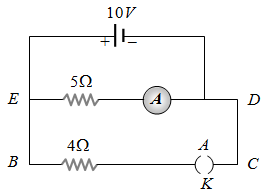
In the given figure, when key K is opened, the reading of the ammeter A will be

In a $YDSE$, the central bright fringe can be identified :
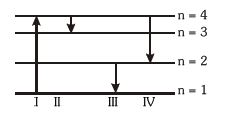
The diagram shown the energy levels for an electron in a certain atom. Which transition shown represents the emission of a photon with the most energy ?
The figure indicates the energy level diagram of an atom and the origin of six spectral lines in emission (e.g. line no. 5 arises from the transition from level B to A). The following spectral lines will also occur in the absorption spectrum
The de$-$Broglie wavelength of a particle moving with a velocity $2.25 \times 10^8 m/s$ is equal to the wavelength of photon. The ratio of kinetic energy of the particle to the energy of the photon is $($velocity of light is $3 \times 10^8\ m/s)$
A deviation of $2^{\circ}$ is produced in the yellow ray when prism of crown and flint glass are achromatically combined. Taking dispersive powers of crown and flint glass are $0.02$ and $0.03$ respectively and refractive index for yellow light for these glasses are $1.5$ and $1.6$ respectively. The refracting angles for crown glass prism will be $........\,^{\circ}$ (in degree) (Round off to the Nearest Integer)
The valence of an impurity added to germanium crystal in order to convert it into a $ P-$ type semi conductor is
A circular disc is placed in front of a narrow source. When the point of observation is $2\, m$ from the disc, then it covers first $HPZ$. The intensity at this point is $I$. When the point of observation is $25\,cm$ from the disc then intensity will be
Two long straight parallel wires, carrying (adjustable) current $I_1$ and $I_2$, are kept at a distance $d$ apart. If the force $'F'$ between the two wires is taken as 'positive' when the wires repel each other and 'negative' when the wires attract each other, the graph showing the dependence of $'F'$, on the product $I_1 I_2$, would be