MCQ
Electric lines of force:
  • A
    Exist everywhere.
  • B
    Exist only in the immediate vicinity of electric charges.
  • C
    Exist only when both positive and negative charges are near one another.
  • Are imaginary.

Answer

Correct option: D.
Are imaginary.

Need a full question paper?

Generate a complete, print-ready paper with questions like this in minutes — across 16+ boards, with answer keys.
Start Generating Free

Similar questions

Two long and parallel wires are at a distance of $0.1\, m$ and a current of $5\, A$ is flowing in each of these wires. The force per unit length due to these wires will be
If the apertature of a telescope is decreased the resolving power will:
In Thomson's experiment if the value of q/m is the same for all positive ions striking the photographic plate, then the trace would be
Alpha rays emitted from a radioactive substance are
Who first proposed the light as an electromagnetic wave?
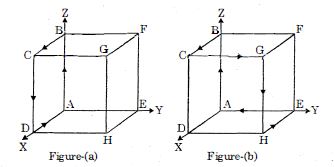
Current $I$ is flowing along the path $ABCDA$ consisting of four edges of a cube (figure $-a$), produces a magnetic field $B_0$ at the centre of the cube. Find the magnetic field $B$ produced at the center of the cube by a current $I$ flowing along the path of the six edges $ABCGHEA$ (figure $b$)
In a region of uniform magnetic induction $B=10^{-2}$ Tesla, a circular coil of radius 30 cm and resistance $\pi^2$ ohm is rotated about an axis which is perpendicular to the direction of B and which forms a diameter of the coil. If the coil rotates at 200 rpm the amplitude of the alternating current induced in the coil is
Two bodies $A$ and $B$ having equal surface areas are maintained at temperatures $10^\circ C$ and $20^\circ C$. The thermal radiation emitted in a given time by $A$ and $B$ are in the ratio :
A radioactive substance has a half-life of 1 year. The fraction of this material, that would remain after 5 years will be
In a Young's double slit experiment, the separation between the two slits is $d$ and the wavelength of the light is $\lambda$. The intensity of light falling on slit $1$ is four times the intensity of light falling on slit $2$. Choose the correct choice$(s)$.

$(A)$ If $\mathrm{d}=\lambda$, the screen will contain only one maximum

$(B)$ If $\lambda<\mathrm{d} < 2 \lambda$, at least one more maximum (besides the central maximum) will be observed on the screen

$(C)$ If the intensity of light falling on slit $1$ is reduced so that it becomes equal to that of slit $2$ , the intensities of the observed dark and bright fringes will increase

$(D)$ If the intensity of light falling on slit $2$ is increased so that it becomes equal to that of slit $1$ , the intensities of the observed dark and bright fringes will increase