Question

Electric potential is given by T, hen electric force acting on 2C  point charge placed on origin will be

(a) 2N

(b) 6N

(c) 8N   

(d) 20 N

Answer

(d) 20 N

Need a full question paper?

Generate a complete, print-ready paper with questions like this in minutes — across 16+ boards, with answer keys.

Start Generating Free

Similar questions

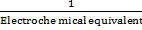
According to Faraday's laws of electrolysis, the amount of decomposition is proportional to

(a)  

(b) Electrochemical equivalent of the substance

(c)

(d)

In a semiconductor diode, the depletion region is removed when:
Force on any charge due to a number of other charges is the _____ of all the forces on that charge taken one at a time.
The reactance of a circuit is zero. It is possible that the circuit contains:
  1. An inductor and a capacitor.
  2. An inductor but no capacitor.
  3. A capacitor but no inductor.
  4. Neither an inductor nor a capacitor.

The energy that should be added to an electron to reduce its de Broglie wavelength from one nm to 0.5 nm is

(a) Four times the initial energy      

(b) Equal to the initial energy

(c) Twice the initial energy

(d) Thrice the initial energy

A moving coil galvanometer has N number of turns in a coil of effective area A, it carries a current I. The magnetic field B is radial. The torque acting on the coil is

(a)  

(b)  

(c)  

(d) NABI

What is the SI unit of self-inductance?

Two insulated charged spheres of radii 20 cm and 25 cm respectively and having an equal charge Q are connected by a copper wire, then they are separated

(a) Both the spheres will have the same charge Q

(b) Charge on the 20 cm  sphere will be greater than that on the 25 cm  sphere

(c) Charge on the 25 cm  sphere will be greater than that on the 20 cm  sphere

(d) Charge on each of the sphere will be 2Q

A linearly polarized electromagnetic wave given as $\text{E}=\text{E}_0\hat{\text{i}}\cos(\text{kz}-\omega\text{t})$ is incident normally on a perfectly reflecting infinite wall at z = a. Assuming that the material of the wall is optically inactive, the reflected wave will be given as:

In a wave, the path difference corresponding to a phase difference of f is

(a)  

(b)

(c)

(d)