Question
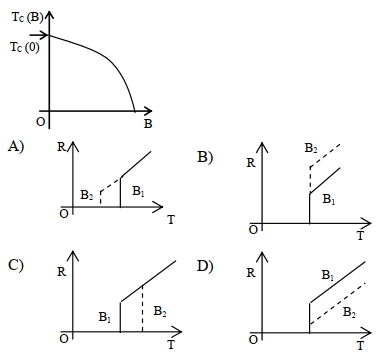
Electrical resistance of certain materials, known as superconductors, changes abruptly from a nonzero value to zero as their temperature is lowered below a critical temperature $T_c(0)$. An interesting property of superconductors is that their critical temperature becomes smaller than $T_c(0)$ if they are placed in a magnetic field, i.e., the critical temperature $T_c(B)$ is a function of the magnetic field strength $B$. The dependence of $T_c(B)$ on $B$ is shown in the figure. $Image$

$1.$ In the graphs below, the resistance $\mathrm{R}$ of a superconductor is shown as a function of its temperature $\mathrm{T}$ for two different magnetic fields $\mathrm{B}_1$ (solid line) and $\mathrm{B}_2$ (dashed line). If $\mathrm{B}_2$ is larger than $\mathrm{B}_1$ which of the following graphs shows the correct variation of $\mathrm{R}$ with $\mathrm{T}$ in these fields?

MCQ $Image$

$2.$ A superconductor has $T_C(0)=100 \mathrm{~K}$. When a magnetic field of 7.5 Tesla is applied, its $\mathrm{T}_{\mathrm{c}}$ decreases to $75 \mathrm{~K}$. For this material one can definitely say that when

$(A)$ $\mathrm{B}=5$ Tesla, $\mathrm{T}_{\mathrm{c}}(\mathrm{B})=80 \mathrm{~K}$

$(B)$ $\mathrm{B}=5$ Tesla, $75 \mathrm{~K}<\mathrm{T}_{\mathrm{c}}(\mathrm{B})<100 \mathrm{~K}$

$(C)$ $\mathrm{B}=10 \mathrm{Tesla}, 75 \mathrm{~K}<\mathrm{T}_{\mathrm{c}}<100 \mathrm{~K}$

$(D)$ $\mathrm{B}=10$ Tesla, $\mathrm{T}_{\mathrm{c}}=70 \mathrm{~K}$

Give the answer question $1, 2$
Answer

$1.$ Larger the magnetic field smaller the critical temperature.

Need a full question paper?

Generate a complete, print-ready paper with questions like this in minutes — across 16+ boards, with answer keys.

Start Generating Free

Similar questions

If acceleration due to gravity on the surface of a planet is two times that on surface of earth and its radius is double that of earth. Then escape velocity from the surface of that planet in comparison to earth will be
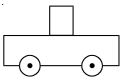
$A$ uniform cylinder rests on a cart as shown. The coefficient of static friction between the cylinder and the cart is $0.5$. If the cylinder is $4\, cm$ in diameter and $10\, cm$ in height, which of the following is the minimum acceleration of the cart needed to cause the cylinder to tip over ? ....... $m/s^2$.
Two simple pendulums whose lengths are $100 cm$ and $121 cm$ are suspended side by side. Their bobs are pulled together and then released. After how many minimum oscillations of the longer pendulum, will the two be in phase again
A balloon is at a height of $81\, m$ and is ascending upwards with a velocity of $12 \,m/s$. A body of $2\,kg$ weight is dropped from it. If $g = 10\,m/{s^2}$, the body will reach the surface of the earth in.........$s$
If the focal length of objective lens is increased then magnifying power of
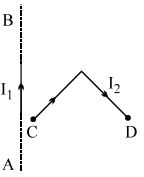
In the figure shown a current $I_1$ is established in the long straight wire $AB$.Another wire $CD$ carrying current $I_2$ is placed in the plane of the paper. The line joining the ends of this wire is perpendicular to the wire $AB$. The force on the wire $CD$ is:
Choose the correct option relating wavelengths of differnet parts of electromagnetic wave spectrum
A particle of mass $0.50 \mathrm{~kg}$ executes simple harmonic motion under force $\mathrm{F}=-50\left(\mathrm{Nm}^{-1}\right) \mathrm{x}$. The time period of oscillation is $\frac{x}{35} s$. The value of $x$ is . . . . .(Given $\pi=\frac{22}{7}$ )
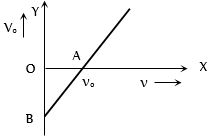
In an experiment on photoelectric effect the frequency $f$ of the incident light is plotted against the stopping potential ${V_0}$. The work function of the photoelectric surface is given by ($e$ is electronic charge)
The mass of the earth is $81$ times that of the moon and the radius of the earth is $3.5$ times that of the moon. The ratio of the acceleration due to gravity at the surface of the moon to that at the surface of the earth is