MCQ
Electrolyte can conduct electricity because
  • A
    Their molecules contain unpaired electrons, which are mobile
  • B
    Their molecules contain loosely held electrons which get free under the influence of voltage
  • C
    The molecules break up into ions when a voltage is applied
  • The molecules are broken up into ions when the electrolyte is fused or is dissolved in the solvent

Answer

Correct option: D.
The molecules are broken up into ions when the electrolyte is fused or is dissolved in the solvent
d
The electrolyte can conduct electricity because the molecules are broken up into ions. When the electrolyte is fused or is dissolved in the solvent, these broken up molecules allow conduction of electricity in the solution.

Need a full question paper?

Generate a complete, print-ready paper with questions like this in minutes — across 16+ boards, with answer keys.

Start Generating Free

Similar questions

The prefix ${10^{18}}$ is
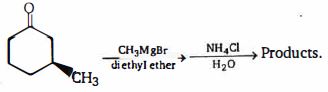
Comment on optical activity of the products. They are
Point out the wrong statement :In a given period of the periodic table the $s$ - block element has, in general, a lower value of
The unit of ionic product of water ${K_w}$ are
Which of the following compound gives pink colour on reaction with phthalic anhydride in conc. $H _{2} SO _{4}$ followed by treatment with $NaOH$ $?$
A gas expands against a variable pressure given by $P = \frac{20}{V}$ $(P$ in $atm$ and $V$ in $L)$. During expansion from volume of $1\, litre$ to $10 \,litre$, the gas undergoes an increase in internal energy of $400\, J$. How much heat is absorbed by gas  during expansion.....$J$
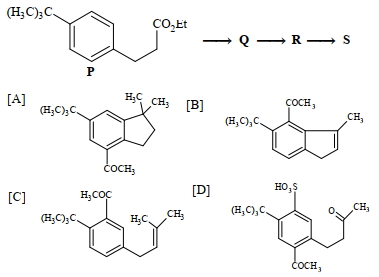
The reaction of compound $\mathbf{P}$ with $CH_3 MgBr$ (excess) in $\left(C_2 \mathrm{H}_5\right)_2 O$ followed by addition of $H_2 O$ gives $Q$. The compound $Q$ on treatment with $H_2 SO_4$ at $0^{\circ} C$ gives $R$. The reaction of $R$ with $CH_3 COC1$ in the presence of anhydrous $AlCl_3$ in $CH_2 Cl_2$ followed by treatment with $H_2 O$ produces compound $S$ [ $Et$ in compound $P$ is ethyl group]

(image)

($1$) The product $S$ is

(image)

($2$) The reactions, $Q$ to $R$ and $R$ to $S$, are

$[A]$ Dehydration and Friedel-Crafts acylation

$[B]$ Aromatic sulfonation and Friedel-Crafts acylation

$[C]$ Friedel-Crafts alkylation, dehydration and Friedel-Crafts acylation

$[D]$ Friedel-Crafts alkylation and Friedel-Crafts acylation

Given the answer quetion ($1$) and ($2$)
When a substance is dissolved in a solvent, the vapour pressure of the solvent is decreased. This results in
$x =$ moles of $KOH$ consumed is
The order of melting point of ortho, para, meta-nitrophenol is