MCQ
Electrolytes when dissolved in water dissociates into ions because
  • A
    They are unstable
  • B
    The water dissolves it
  • C
    The force of repulsion increases
  • The forces of electrostatic attraction are broken down by water

Answer

Correct option: D.
The forces of electrostatic attraction are broken down by water
d
Electrolytes when dissolved in water dissociates completely or partially to form ions. Example $NaCl$ when dissolved in water dissociates to $Na ^{+}$ and $Cl ^{-}$ ions. Thus $NaCl$ is a good electrolyte.

Electrolytes when dissolved in water can conduct electricity. Because positive and negative ions are present in the solution because of the dissociation of the electrolytes in the solution.

Need a full question paper?

Generate a complete, print-ready paper with questions like this in minutes — across 16+ boards, with answer keys.
Start Generating Free

Similar questions

Assertion : Equal moles of different substances contain same number of constituent particles.
Reason : Equal weights of different substances contain the same number of constituent particles.
In the cell $Zn\,\,|\,\,Z{n^{2 + }}\,\,||\,\,C{u^{2 + }}\,\,|\,\,Cu,$ the negative electrode is
Which is major product formed when acetone is heated with iodine and potassium hydroxide?
If an iron rod is dipped in $CuS{O_4}$ solution
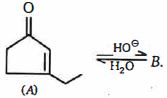
$(A)$ and $(B)$ are isomer : Identify $(B)$
The dipole moment is zero for the molecule
In an experiment, $50\,mL$ of $0.1\,M$ solution of a metal salt reacted with $25\,mL$ of $0.1\,M$ solution of sodium sulphite. The half equation for the oxidation of sulphite ion is $S{O_3}^{2 - }\left( {aq} \right) + {H_2}O\left( l \right) \to S{O_4}^{2 - }\left( {aq} \right) + 2{H^ + }\left( {aq} \right) + 2{e^ - }$

If the oxidation number of metal in the salt was $3$, what would be the new oxidation number of metal ?

Which pair never represents $X$ and $Y$ in the  following reaction

Reaction :  $X\xrightarrow{{'Y'}}CHC{l_3} + Z$

Sodium thiosulphate is used to remove the unexposed $AgBr$ from photographic films by forming a complex. In this complex of silver, the coordination number of silver is
At a given temperature, the equilibrium constant for reaction $PC{l_5}_{(g)}$ $\rightleftharpoons$ $PC{l_3}_{(g)} + C{l_2}_{(g)}$ is $2.4 \times {10^{ - 3}}$. At the same temperature, the equilibrium constant for reaction $PC{l_3}_{(g)} + C{l_2}_{(g)}$ $\rightleftharpoons$ $PC{l_5}_{(g)}$ is