MCQ
Electromagentic waves were produced in laboratory first by:
  • A
    Maxwell
  • B
    Faraday
  • C
    Ampere
  • Hertz

Answer

Correct option: D.
Hertz
D

Need a full question paper?

Generate a complete, print-ready paper with questions like this in minutes — across 16+ boards, with answer keys.
Start Generating Free

Similar questions

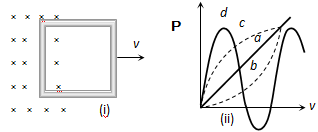
Figure $(i)$ shows a conducting loop being pulled out of a magnetic field with a speed $v.$ Which of the four plots shown in figure $(ii)$ may represent the power delivered by the pulling agent as a function of the speed $v$

 
A potential difference of $2 V$ is applied between the opposite faces of a $Ge$ crystal plate of area $1\ cm^2$ and thickness $0.5\  mm$ . If the concentration of electrons in $Ge$ is $2 \times 10^{19} / m ^3$ and mobilities of electrons and holes are $0.36 \frac{m^2}{ volt - sec }$ and $0.14 \frac{m^2}{ volt - sec }$ respectively, then the current flowing through the plate will be
The impurity atoms with which pure silicon may be doped to make it a p-type semiconductor are those of:
Assertion  :   There is no atmosphere on moon
Reason      : Escape velocity at the surface of moon is low.(a) If both assertion and reason are true and the reason is the correct explanation of the assertion.(b) If both assertion and reason are true but reason is not the correct explanation of the assertion.(c) If assertion is true but reason is false.(d) If the assertion and reason both are false.


In $X-$ray experiment $K_a, K_b$ denotes
Three capacitors each of capacitance $1 \mu F$ are connected in parallel. To this combination, a fourth capacitor of capacitance $1 \mu F$ is connected in series. The resultant capacitance of the system is
Gauss is unit of which quantity(a) H(b) B(c) ∅(d) I
       
The frequency of radio waves corresponding to a wavelength of $10m$ is:
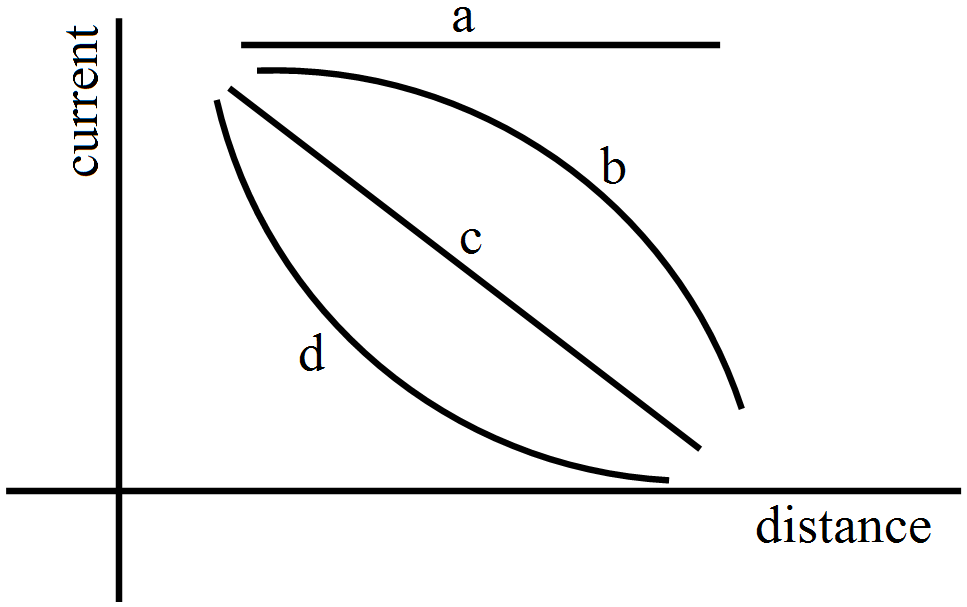
A point source causes photoelectric effect from a small metal plate. Which of the following curves may represent the saturation photocurrent as a function of the distance between the source and the metal?
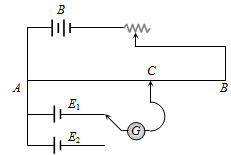
The circuit shown here is used to compare the $\text{e.m.f.}$ of two cells $E _1$ and $E _2\left( E _1> E _2\right)$. The null point is at $C$ when the galvanometer is connected to $E _1$. When the galvanometer is connected to $E _2$, the null point will be