Question
Electromagnetic waves are produced by:
  1. A static charge.
  2. A moving charge.
  3. An accelerating charge.
  4. Chargeless particles.

Answer

  1. An accelerating charge.

Explanation:

A static charge produces an electrostatic field. A moving charge produces a magnetic field. Electromagnetic waves are produced by an accelerating charge.

Need a full question paper?

Generate a complete, print-ready paper with questions like this in minutes — across 16+ boards, with answer keys.
Start Generating Free

Similar questions

Two waves having sinusoidal waveforms have different wavelengths and different amplitude. They will be having
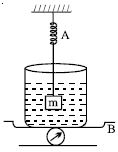
The spring balance $A$ reads $2$ $kg$ with a block $m $ suspended from it. $A$ balance $B$ reads $5$ $kg$ when a beaker with liquid is put on the pan of the balance. The two balances are now so arranged that the hanging mass is inside the liquid in the beaker as shown in the figure in this situation:
The linear mass density of a thin rod $A B$ of length $L$ varies from $A$ to $B$ as $\lambda( x )=\lambda_{0}\left(1+\frac{ x }{ L }\right),$ where $x$ is the distance from A. If $M$ is the mass of the rod then its moment of inertia about an axis passing through $A$ and perpendicular to the rod is$......ML^{2}$
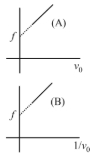
A source of sound emits sound waves at frequency $f_0$. It is moving towards an observer with fixed speed $v_s$ ($v_s < v$, where $v$ is the speed of sound in air). If the observer were to move towards the source with speed $v_0$, one of the following two graphs ($A$ and $B$) will given the correct variation of the frequency $f$ heard by the observer as $v_0$ is changed The variation of $f$ with $v_0$ is given correctly by
$A$ body $A$ is thrown vertically upwards with such a velocity that it reaches a maximum height of $h$. Simultaneously another body $B$ is dropped from height $h$. It strikes the ground and does not rebound. The velocity of $A$ relative to $B v/s$ time graph is best represented by : (upward direction is positive)
In a seconds pendulum, mass of bob is $30\, g$. If it is replaced by $90\, g$ mass. Then its time period will be ... $\sec$
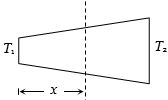
Radius of a conductor increases uniformly from left end to right end as shown in fig.Material of the conductor is isotropic and its curved surface is thermally isolated from surrounding. Its ends are maintained at temperatures $T_1$ and $T_2$ ($T_1$ > $T_2$): If, in steady state, heat flow rate is equal to $H$ , then which of the following graphs is correct
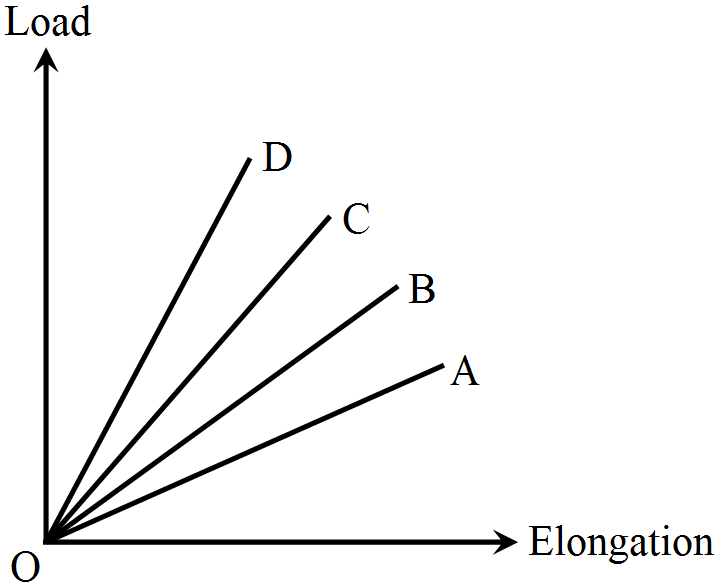
The load versus elongation graph for four wires of the same material is shown in the fig. The thinnest wire is represented by the line.

A liquid boils when its vapour pressure equals
A body of mass $2\, kg$ is being dragged with uniform velocity of $2\, m/s$ on a rough horizontal plane. The coefficient of friction between the body and the surface is $0.20$. The amount of heat generated in $5 sec$ is ........ $cal$ $(J = 4.2\,joule/cal$ and $g = 9.8\,m/{s^2})$