MCQ
Electromagnetic waves are produced by:
  • A
    A static charge.
  • B
    A moving charge.
  • An accelerating charge.
  • D
    Chargeless particles.

Answer

Correct option: C.
An accelerating charge.
A static charge produces an electrostatic field. A moving charge produces a magnetic field. Electromagnetic waves are produced by an accelerating charge.

Need a full question paper?

Generate a complete, print-ready paper with questions like this in minutes — across 16+ boards, with answer keys.
Start Generating Free

Similar questions

The frequency of $1^{\text {st }}$ line of Balmer series in $H _2$ atom is $v _0$. The frequency of line emitted by singly ionised He atom is
$12$ cells each having same $emf$ are connected in series with some cells wrongly connected. The arrangement is connected in series with an ammeter and two cells which are in series. Current is $3 \,A$ when cells and battery aid each other and is $2\, A$ when cells and battery oppose each other. The number of cells wrongly connected is
The rest mass of an electron as well as that of positron is $0.51\, MeV$. When an electron and positron are annihilate, they produce gamma-rays of wavelength(s)
Two light beams of intensities $4\,I$ and $9\,I$ interfere on a screen. The phase difference between these beams on the screen at point $A$ is $zero$ and at point $B$ is $\pi$. The difference of resultant intensities, at the point $A$ and $B$, will be $....I$.
Electron of mass $m$ and charge $q$ is travelling with a speed along a circular path of radius $r$ at right angles to a uniform magnetic field of intensity $B$. If the speed of the electron is doubled and the magnetic field is halved the resulting path would have a radius
The apparent depth of a needle lying at the bottom of the tank, which is filled with water of refractive index $1.33$ to a height of $12.5\,cm$ is measured by a microscope to be $9.4\,cm$. If water is replaced by a liquid of refractive index $1.5$ upto the same height. What distance would the microscope have to be moved to focus on the needle again ?......$cm$
The ionisation potential of hydrogen atom is 13.6 volt. The energy required to remove an electron in the n = 2 state of the hydrogen atom is
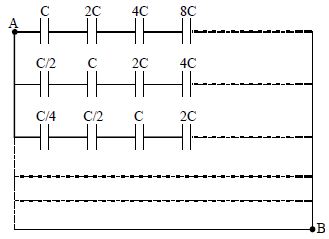
Consider an infinite matrix of capacitors as shown in the figure. The effective capacitance between point $A$ and $B$ will be
For observing a cricket match, a binocular is preferred to a terrestrial telescope because
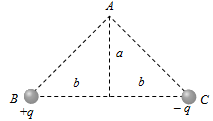
As shown in the figure, charges +q and -q are placed at the vertices B and C of an isosceles triangle. The potential at the vertex A is