MCQ
Electromagnetic waves are produced by:
  • A
    A static charge.
  • B
    A moving charge.
  • An accelerating charge.
  • D
    Chargeless particles.

Answer

Correct option: C.
An accelerating charge.

A static charge produces an electrostatic field. A moving charge produces a magnetic field. Electromagnetic waves are produced by an accelerating charge.

Need a full question paper?

Generate a complete, print-ready paper with questions like this in minutes — across 16+ boards, with answer keys.
Start Generating Free

Similar questions

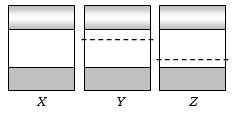
The energy band diagrams for three semiconductor samples of silicon are as shown. We can then assert that
Bonding in a germanium crystal (semi- conductor) is
The wavelength of sodium light in air is $5890 \mathring A$. The velocity of light in air is $3 \times 10^8 ms^{-1}$. The wavelength of light in a glass of refractive index 1.6 would be close to
When the current flowing in a circular coil is doubled and the number of turns of the coil in it is halved, the magnetic field at its centre will become
In a biprism experiment, by using light of wavelength 5000 Å, 5 mm wide fringes are obtained on a screen 1.0 m away from the coherent sources. The separation between the two coherent sources is
A magnet of magnetic moment M and pole strength m is divided in two equal parts, then magnetic moment of each part will be
A charged particle is moved along a magnetic field line. The magnetic force on the particle is:
Three fourth of the active decays in a radioactive sample in 3/4 sec. The half life of the sample is 
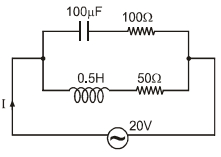
In the given circuit, the $AC$ source has $\omega=100 \ rad / s$. considering the inductor and capacitor to be ideal, the correct choice $(s)$ is(are)

$(A)$ The current through the circuit, $I$ is $0.3 \ A$

$(B)$ The current through the circuit, I is $0.3 \sqrt{2} \ A$.

$(C)$ The voltage across $100 \Omega$ resistor $=10 \sqrt{2} \ V$

$(D)$ The voltage across $50 \Omega$ resistor $=10 \ V$
The two light beams having intensities I and 9I interfere to produce a fringe pattern on a screen. The phase difference between the beams is $\frac{\pi}{2}$ at point $P$ and $\pi$ at point $Q$. Then the difference between the resultant intensities at $P$ and $Q$ will be.......$I$