MCQ
Electromagnetic waves travel only through.
- Amaterial medium
- Bvacuum
- Coscillating electric and magnetic fields
- Doscillating electric and magnetic fields whose directions are perpendicular to each other
Explanation:
Electromagnetic waves travel through oscillating electric and magnetic fields whose directions are perpendicular to each other.
Generate a complete, print-ready paper with questions like this in minutes — across 16+ boards, with answer keys.
A 10 pF capacitor is connected to a 50 V battery. How much electrostatic energy is stored in the capacitor
|
(a) 1.25 |
(b) 2.5 |
(c) 3.5 |
(d) 4.5 |
The capacity of a condenser in which a dielectric of dielectric constant 5 has been used, is C. If the dielectric is replaced by another with dielectric constant 20, the capacity will become
|
(a) |
(b) 4C |
(c) |
(d) 2C |
Below figures (1) and (2) represent lines of force. Which is correct statement

|
(a) Figure (1) represents magnetic lines of force |
|
(b) Figure (2) represents magnetic lines of force |
|
(c) Figure (1) represents electric lines of force |
|
(d) Both figure (1) and figure (2) represent magnetic lines of force |
The X-ray beam coming from an X-ray tube will be
| (a) Monochromatic |
|
(b) Having all wavelengths smaller than a certain maximum wavelength |
|
(c) Having all wavelengths larger than a certain minimum wavelength |
|
(d) Having all wavelengths lying between a minimum and a maximum wavelength |
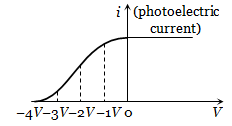
The value of stopping potential in the following diagram
|
(a) – 4V |
(b) – 3 V |
(c) – 2V |
(d) – 1 V |
A diminished image of an object is to be obtained on a screen 1.0 m from it. This can be achieved by appropriately placing
|
(a) A convex mirror of suitable focal length |
|
(b) A concave mirror of suitable focal length |
|
(c) A concave lens of suitable focal length |
|
(d) A convex lens of suitable focal length less than 0.25 m |
 nucleus after absorbing energy decays into two α - particles and an unknown nucleus. The unknown nucleus is
|
(a) Nitrogen |
(b) Carbon |
(c) Boron |
(d) Oxygen |


