MCQ
Electromagnetic waves
  • Follow the principle of superposition
  • B
    Do not follow the principle of superposition
  • C
    Only show superposition
  • D
    Only show interference

Answer

Correct option: A.
Follow the principle of superposition
(a)Follow the principle of superposition

Need a full question paper?

Generate a complete, print-ready paper with questions like this in minutes — across 16+ boards, with answer keys.
Start Generating Free

Similar questions

When monochromatic radiation of intensity $I$ falls on a metal surface, the number of photoelectrons and their maximum kinetic energy are $N$ and $K$ respectively. If the intensity of radiation is $2I$, the number of emitted electrons and their maximum kinetic energy are respectively
Two $220\; V , 100 \;W$ bulbs are connected first in series and then in parallel. Each time the combination is connected to a $220 \;V \;AC$ supply line. The power drawn by the combination in each case respectively will be
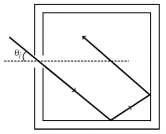
A monochromatic beam of light enters a square enclosure with mirrored interior surfaces at an angle of incidence $\theta_i(\neq 0)$ (see figure). For some value(s) of $\theta_i$, the beam is reflected by every mirrored wall (other than the one with the opening) exactly once and exits the enclosure through the same hole. Which of the following statements about this beam is correct?
In the hysteresis cycle, the value of H needed to make the intensity of magnetisation zero is called
The a-particle is the nucleus of an atom of
A short magnet oscillates with a time period $0.1\, s$ at a place where horizontal magnetic field is $24\,\mu T.$ A downward current of $18 \,A$ is established in a vertical wire $20 \,cm$ east of the magnet. The new time period of oscillator
The magnetic induction at any point due to a long straight wire carrying a current is
The maximum value of electric field on the axis of a charged ring having charge $Q$ and radius $R$ is
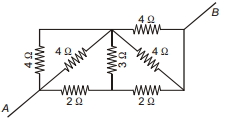
Resistance across $A B$ as shown in figure is ............. $\Omega$
In an $LRC$ series circuit at resonance current in the circuit is $10\sqrt 2\  A$. If now frequency of the source is changed such that now current lags by $45^o$ than applied voltage in the circuit , which of the following is correct