MCQ
Electromotive force of a battery represents:
  • A
    Force.
  • B
    Energy.
  • Electric potential energy per unit charge.
  • D
    Current.

Answer

Correct option: C.
Electric potential energy per unit charge.
When a voltage is generated by a battery, this generated voltage has been traditionally called an electromotive force or emf. The emf represents electric potential energy per unit charge $($voltage$)$ which has been made available to free electrons by the generating mechanism and is not a force.
The term emf is useful to distinguish voltage generated by the battery from those which occur in a circuit as a result of energy dissipation $($ Like Voltage drop across a resistor$).$

Need a full question paper?

Generate a complete, print-ready paper with questions like this in minutes — across 16+ boards, with answer keys.
Start Generating Free

Similar questions

In case of displacement method of lenses, the product of magnification in both cases is
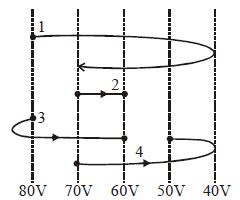
The figure shows a family of parallel equipotential surfaces and four paths along which an electron is made to move from one surface to another as shown in the figur
$(I)$ What is the direction of the electric field ?
$(II)$ Rank the paths according to magnitude of work done, greatest first
When a charged particle moving with velocity $\vec V$ is subjected to a magnetic field of induction $\vec B$ , the force on it is non-zero. This implies the
Which of the following is not transported by electromagnetic waves?
The range of wavelength of the visible light is
The energy associated with electric field is $(U_E)$ and with magnetic field is $(U_B)$ for an electromagnetic wave in free space. Then
An electron having a charge e moves with a velocity v in $X-$direction. An electric field acts on it in $Y-$direction? The force on the electron acts in:
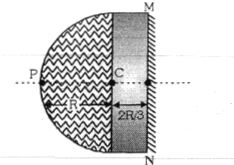
A solid hemisphere of refractive index $\frac{3}{2}$ and radius $R = 20\  cm$ is placed as shown in the figure. Another special cylindrical glass of refractive index $'\mu '$, radius $R$ and thickness $\frac{{2R}}{3}$ is also placed adjacent to flat surface of solid hemisphere. There is a very small luminous spot at $'P'$ just inside the solid hemisphere and $MN$ surface of special glass surface is silvered. (consider only paraxial rays)
Kinetic energy with the electrons are emitted from the metal surface due to photoelectric effect is:
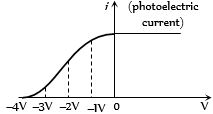
The value of stopping potential in the following diagram ......... $V$