Question
Electron affinity is the
Generate a complete, print-ready paper with questions like this in minutes — across 16+ boards, with answer keys.
$Q + Cl ^{-} \rightarrow X$
$Q + Me _3 N \rightarrow Y$
$Q + CuCl _2 \rightarrow Z + CuCl$
$X$ is a monoanion having pyramidal geometry. Both $Y$ and $Z$ are neutral compounds. Choose the correct option($s$).
$(1)$ The central atoms in $X$ is $sp ^3$ hybridized
$(2)$ The oxidation state of the central atom in $Z$ is $+2$
$(3)$ The central atom in $Z$ has one lone pair of electrons
$(4)$ There is a coordinate bond in $Y$
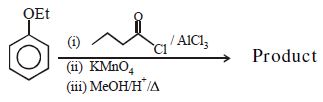

$(a)$ isoleucine
$(b)$ cysteine
$(c)$ lysine
$(d)$ methionine
$(e)$ glutamic acid
$I$. Valence bond theory cannot explain the color exhibited by transition metal complexes
$II$. Valence bond theory can predict quantitatively the magnetic properties of transition metal complexes
$III$. Valence bond theory cannot distinguish ligands as weak and strong field ones