MCQ
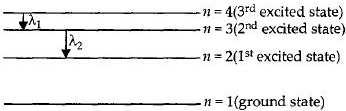
Electron in hydrogen atom first jumps from third excited state to second excited state and then from second excited to the first excited state. The ratio of the  wavelengths $\lambda_1 :\lambda_2$ emitted in the two cases is
  • A
    $\frac{7}{5}$
  • B
    $\;\frac{{27}}{{20}}$
  • C
    $\;\frac{{27}}{5}$
  • $\;\frac{{20}}{7}$

Answer

Correct option: D.
$\;\frac{{20}}{7}$
d
According to Rydberg formula

$\frac{1}{\lambda}=R\left[\frac{1}{n_{f}^{2}}-\frac{1}{n_{i}^{2}}\right]$

In first case, $n_{f}=3, n_{i}=4$

$\therefore \quad \frac{1}{\lambda_{1}}=R\left[\frac{1}{3^{2}}-\frac{1}{4^{2}}\right]=R\left[\frac{1}{9}-\frac{1}{16}\right]=\frac{7}{144} R$    .... $(i)$

In second case, $n_{f}=2, n_{i}=3$

$\therefore \quad \frac{1}{\lambda_{2}}=R\left[\frac{1}{2^{2}}-\frac{1}{3^{2}}\right]=R\left[\frac{1}{4}-\frac{1}{9}\right]=\frac{5}{36} R$    .... $(ii)$

Divide $(ii)$ by $(i)$, we get

$\frac{\lambda_{1}}{\lambda_{2}}=\frac{5}{36} \times \frac{144}{7}=\frac{20}{7}$

Need a full question paper?

Generate a complete, print-ready paper with questions like this in minutes — across 16+ boards, with answer keys.

Start Generating Free

Similar questions

The induction coil works on the principle of
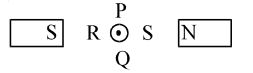
A straight current carrying conductor is placed in such a way that the current in the conductor flows in the direction out of the plane of the paper. The conductor is placed between two poles of two magnets, as shown. The conductor will experience a force in the direction towards
If in a photoelectric cell, the wavelength of incident light is changed from $4000 \mathring A$ to $3000 \mathring A$ then change in stopping potential will be ..... $V$
From Ampere's circuital law for a long straight wire of circular cross-section carrying a steady current, the variation of magnetic field in the inside and outside region of the wire is :
A point mass of $1 \mathrm{~kg}$ collides elastically with a stationary point mass of $5 \mathrm{~kg}$. After their collision, the $1 \mathrm{~kg}$ mass reverses its direction and moves with a speed of $2 \mathrm{~ms}^{-1}$. Which of the following statement(s) is (are) correct for the system of these two masses?

$(A)$ Total momentum of the system is $3 \mathrm{~kg} \mathrm{~ms}^{-1}$

$(B)$ Momentum of $5 \mathrm{~kg}$ mass after collision is $4 \mathrm{~kg} \mathrm{~ms}^{-1}$

$(C)$ Kinetic energy of the centre of mass is $0.75 \mathrm{~J}$

$(D)$ Total kinetic energy of the system is $4 \mathrm{~J}$

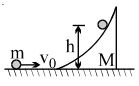
A particle of mass $m$ moving horizontally with $v_0$ strikes $a$ smooth wedge of mass $M$, as shown in figure. After collision, the ball starts moving up the inclined face of the wedge and rises to $a$ height $h$. Choose the correct statement related to the wedge $M$
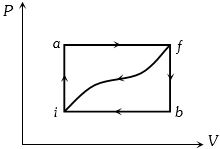
When a system is taken from state $i$ to a state $f$ along path $iaf, \,Q = 50\,J$ and $W = 20J.$ Along path $ibf, \,Q = 35J.$ If $W = - 13J$ for the curved return path $f i, Q$ for this path is ...... $J$
Which of the following is not transported by electromagnetic waves?
$Assertion :$ Bodies radiate heat at all temperature.
$Reason :$ Rate of radiation of heat is proportional to the fourth power of absolute temperature.
According to Newton’s law of cooling, the rate of cooling of a body is proportional to ${(\Delta \theta )^n}$, where $\Delta \theta $ is the difference of the temperature of the body and the surroundings, and n is equal to