Question
Electrons are continuously in motion within a conductor but there is no current in it unless some source of potential is applied across its ends. Give reason.

Answer

In the absence of any external source the motion of electrons in a conductor is random and electrons collide continuously with the positive ions of metal. This causes a random change in direction of motion. The average velocity of random motion of electrons in any direction is zero, hence current is zero.

Need a full question paper?

Generate a complete, print-ready paper with questions like this in minutes — across 16+ boards, with answer keys.
Start Generating Free

Similar questions

The half-life of a radioisotope is 10h. Find the total number of disintegrations in the tenth hour measured from a time when the activity was 1Ci.
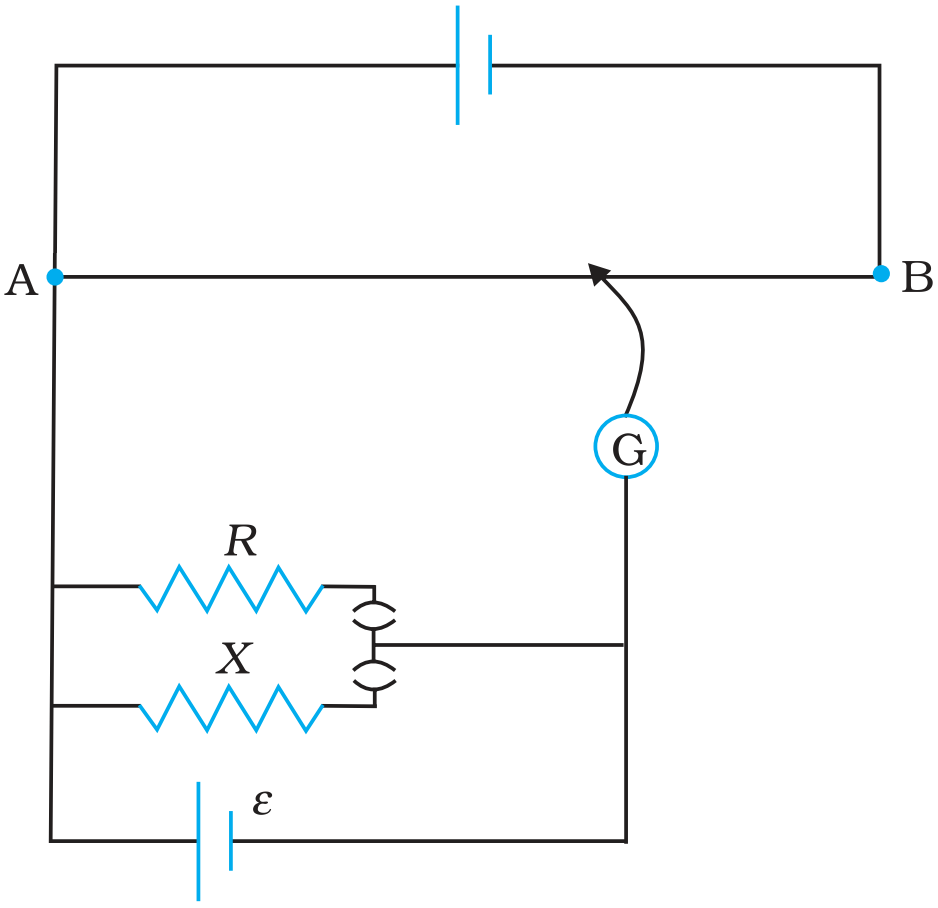
Figure shows a potentiometer circuit for comparison of two resistances. The balance point with a standard resistor $\text{R}=10.0\ \Omega$ is found to be 58.3 cm, while that with the unknown resistance X is 68.5 cm. Determine the value of X. What might you do if you failed to find a balance point with the given cell of emf $\varepsilon?$
Consider the situation of the previous problem. A particle having charge q and mass m is projected from the point Q in a direction going into the plane of the diagram. It is found to describe a circle of radius r between the two plates. Find the speed of the charged particle.
A particle of mass ‘m’, with charge ‘q’ moving with a uniform speed ‘v’, normal to a uniform magnetic field ‘B’, describes a circular path of radius ‘r’. Derive expressions for the:
  1. Time period of revolution.
  2. Kinetic energy of the particle.
Show that the wavelength of electromagnetic radiation is equal to the de Broglie wavelength of its quantum (photon).
A long, vertical wire carrying a current of 10A in the upward direction is placed in a region where a horizontal magnetic field of magnitude $2·0 \times 10^{-3}T$ exists from south to north. Find the point where the resultant magnetic field is zero.
Radius of a disc of copper is 10 cm . It is rotating about an axis which is perpendicular to its plane and passing through its centre at the rate of $20 \pi rad /$ second. Uniform magnetic field of 0.2 T is working perpendicular to the disc. (i) Calculate potential difference between axis and circumference of the disc. (ii) If resistance of disc is 2 , then what is the magnitude of induced current?
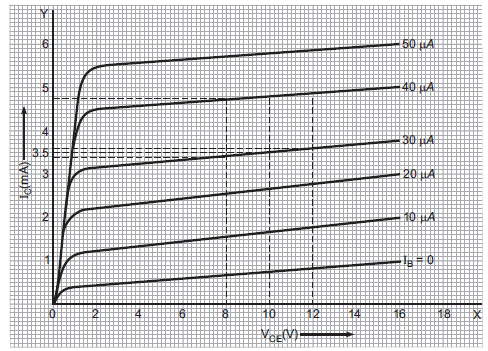
Output characteristics of an n-p-n transistor in CE configuration is shown in the figure. Determine:
  1. Dynamic output resistance.
  2. Dc current gain and.
  3. Ac current gain at an operating point $V_{CE} = 10V$, when $I_B =30 \mu A.$
A certain sample of a radioactive material decays at the rate of 500 per second at a certain time. The count rate falls to 200 per second after 50 minutes.
  1. What is the decay constant of the sample?
  2. What is its half-life?
A certain material has refractive indices 1.56, 1.60 and 1.68 for red, yellow and violet light respectively.
  1. Calculate the dispersive power.
  2. Find the angular dispersion produced by a thin prism of angle 6° made of this material.