MCQ
Electrons in the atom are held to the nucleus by:
  • Coulomb’s force.
  • B
    Nuclear force.
  • C
    Vander waal’s force.
  • D
    Gravitational force.

Answer

Correct option: A.
Coulomb’s force.

Need a full question paper?

Generate a complete, print-ready paper with questions like this in minutes — across 16+ boards, with answer keys.

Start Generating Free

Similar questions

Young's experiment is performed in air and then performed in water, the fringe width
Two streams of electrons are moving parallel to each other in the same direction. They $.......$
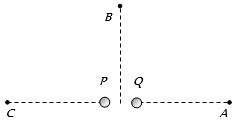
Figure here shows $P$ and $Q$ as two equally intense coherent sources emitting radiations of wavelength $20 \,m$. The separation $PQ$ is $5.0 \,m$ and phase of $P$ is ahead of the phase of $Q$ by $90^{0}$. $A, B $ and $ C$ are three distant points of observation equidistant from the mid-point of $PQ$. The intensity of radiations at $A, B, C$  will bear the ratio
The intensity of the electric field required to keep a water drop of radius ${10^{ - 5}}\, cm$ just suspended in air when charged with one electron is approximately
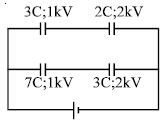
The diagram shows four capacitors with capacitances and break down voltages as mentioned. What should be the maximum value of the external emf source such that no capacitor breaks down ? .......$kV$
A hydrogen atom in ground state absorbs $10.2\ eV$ of energy. The orbital angular momentum of the electron is increased by:
In $\mathrm{CuSO}_4$ solution when electric current equal to 2.5 faraday is passed, the gm equivalent deposited on the cathode is
A beam of light converges at a point $P$ . Now a lens is placed in the path of the convergent beam $12\,cm$ from $P$ . At what point does the beam converge if the lens is a convex lens of focal length $20\,cm$............$cm$
A charge particle $q_0$ of mass $m_0$ is projected along the $y-$axis at $t = 0$ from origin with a velocity $V_0.$ If a uniform electron field $E_0$ also exists along the $x-$ axis, then the time at which de-broglie wavelength of the particle  becomes half of the initial value is
A hydrogen atom in its ground state absorbs 10.2 eV of energy. The orbital angular momentum is increased by