Question
Electroplating does not help in(a) Fine finish to the surface(b) Shining appearance(c) Metals to become hard(d) Protect metal against corrosion


Answer

(c) Metals to become hard

Need a full question paper?

Generate a complete, print-ready paper with questions like this in minutes — across 16+ boards, with answer keys.
Start Generating Free

Similar questions

Electric charges are distributed in a small volume. The flux of the electric field through a spherical surface of radius $10\ cm$ surrounding the total charge is $25V-m.$ The flux over a concentric sphere of radius $20\ cm$ will be:
In a sample of radioactive material, what percentage of the initial number of active nuclei will decay during one mean life(a) 69.3%  (b) 63%(c) 50%(d) 37%
       
Who discovered the first spectral series?
A photoelectric cell is a device which?
A charge of 5 C  is given a displacement of 0.5 m. The work done in the process is 10 J. The potential difference between the two points will be (a) 2 V(b) 0.25 V (c) 1V(d) 25 V    
       
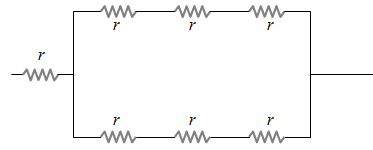
Referring to the figure below, the effective resistance of the network is
A spherical surface of radius of curvature R separates air (refractive index 1.0) from glass (refractive index 1.5). The centre of curvature is in the glass. A point object P placed in air is found to have a real image Q in the glass. The line PQ cuts the surface at a point O, and PO = OQ. The distance PO is equal to (a) 5 R(b) 3 R(c) 2 R(d) 1.5 R
       
Assertion  :  A transistor amplifier in common emitter configuration has a low input impedence.
Reason      : The base to emitter region is forward biased.(a) If both assertion and reason are true and the reason is the correct explanation of the assertion.(b) If both assertion and reason are true but reason is not the correct explanation of the assertion.(c) If assertion is true but reason is false.(d) If the assertion and reason both are false.


Two lenses having $f_1 : f_2 = 2 : 3$ has combination to make no dispersion. Find the ratio of dispersive power of glasses used
Let $F, F_N$ and $f$ denote the magnitudes of the contact force, normal force and the friction exerted by one surface on the other kept in contact. If none of these is zero: