Question
Elements forming ionic compounds attain noble gas configuration by either gaining or losing electrons from their outermost shells. Give reason to explain why carbon cannot attain noble gas configuration in this manner to form its compounds. Name the type of bonds formed in ionic compounds and in the compounds formed by carbon. Also give reason why carbon compounds are generally poor conductors of electricity.
Answer

Carbon mainly forms covalent bonds because carbon atoms have 4 elections in their outermost shell. So it needs to gain or lose electrons to attain noble gas configuration.
i. It could gain four electrons forming $C ^{4-} C ^{4-}$ anion. But it would be difficult for the nucleus with six protons to hold on to ten electrons.
ii. It could lose four electrons forming $C ^{4+} C ^{4+}$ cation. But it would require a large amount of energy to remove four electrons from its outermost shell.
Because of these reasons, carbon shares its valence electrons to complete its octed with other atoms to form covalent bonds.
Carbon has 4 electrons in its outermost shell. It cannot lose 4 electrons to form $C ^{4+}$ cation because very high energy is required to remove 4 electrons leaving behind a carbon cation with 6 protons in this nucleus holding onto just 2 electrons. It also cannot gain 4 electrons to form $C ^4$ anion because it is difficult for 6 protons to hold onto 10 electrons. The type of bonds formed in ionic compounds is ionic or electrovalent bonds and in compounds formed by carbon are covalent bonds.
Since the electrons are shared, there are no charged particles in carbon compounds and hence they are poor conductors of electricity.

Need a full question paper?

Generate a complete, print-ready paper with questions like this in minutes — across 16+ boards, with answer keys.

Start Generating Free

Similar questions

What is electrical resistivity of a material? What is its unit? Describe an experiment to study the factors on which the resistance of conducting wire depends.
Write the names of five endocrine glands found in the human body. Name the hormones secreted by each gland.
When the solution of substance X is added to a solution of potassium iodide, then a yellow solid separates out from the solution:
  1. What do you think substance X is likely to be?
  2. Name the substance which the yellow solid consists of.
  3. Which characteristic of chemical reaction is illustrated by this example?
  4. Write a balanced chemical equation for the reaction which takes place. Mention the physical states of all the reactant and products involved in the chemical equation.
In the context of conservation of natural resources, explain the terms reduce, recycle and reuse. From among the materials that we use in daily life, identify two materials for each category.
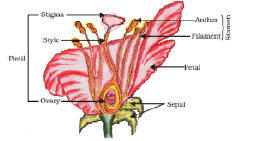
The labelled diagram of a flower is shown below:
Image

Using the above diagram, answer the following questions:
i. Where is the egg cell present in a flower?
ii. Which part of the flower produces pollen grains?
iii. What is the difference between a uni-sexual and a bisexual flower?
iv. What happens when a pollen grain falls on the stigma of the carpel?
v. How a zygote is formed in a flower?
List two advantages associated with water harvesting at the community level.
Each and every respiration organ is structurally specialised in its function. Justify with examples.
  1. Explain the role of placenta in the development of human embryo.
  2. Give example of two bacterial and two viral sexually transmitted diseases. Name the most effective contraceptive which prevents spread of such diseases.
A metal X forms a water soluble salt $XNO _3$. When an aqueous solution of $XNO _3$ is added to common salt solution, then a white precipitate of compound $Y$ is formed alongwith sodium nitrate solution. Metal $X$ is said to be the best conductor of electricity and it does not evolve hydrogen when put in dilute hydrohloric acid.
a. What is metal X ?
b. What is salt $XNO _3$ ?
c. Name the compound Y .
d. Write the chemical equation of the reaction which takes place on reacting $XNO _3$ solution and common salt solution giving the physical states of all the reactants and products.
e. What type of chemical reaction is illustrated by the above equation?
State the basic requirements for sexual reproduction? Write the importance of such reproduction in nature?