MCQ
Elements which generally exhibit variable oxidation states and form colored ions are $........$
  • A
    Metalloids.
  • Transition elements.
  • C
    Non$-$metals.
  • D
    Gases.

Answer

Correct option: B.
Transition elements.
Transition elements have vacant $d$ orbitals and the energy gap between $d$ orbitals is very less. So transition elements exhibit variable oxidation state and form coloured ions as these elements emit radiations due to excitation of $d$ electrons.

Need a full question paper?

Generate a complete, print-ready paper with questions like this in minutes — across 16+ boards, with answer keys.
Start Generating Free

Similar questions

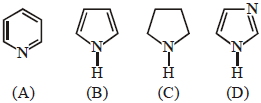
The increasing order of basicity of the following compounds is
Chile salt petre is the nitrate mineral of:
In hydrogenation reaction at ${27\,^o}C$, it is observed that hydrogen gas pressure falls from $2\,atm$ to $1.2\,atm$ in $50\,\min$. Calculate the rate of disappearance of hydrogen
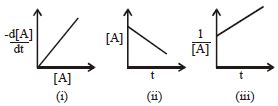
Consider the plots for the types of reaction. $nA \to  B + C$ These plots respectively corresponds to the reaction orders
For the diazonium ions the order of reactivity towards diazo-coupling with phenol  in the presence of dilute $NaOH $ is
Sucrose hydrolyses in acid solution into glucose and fructose following first order rate law with a half-life of $3.33\, h$ at $25^{\circ} C$. After $9 \,h ,$ the fraction of sucrose remaining is $f$. The value of $\log _{10}\left(\frac{1}{f}\right)$ is ..... $\times 10^{-2} .$

(Rounded off to the nearest integer) [Assume : $\ln 10=2.303, \ln 2=0.693$ ]

Which of the following statement is not true for glucose?
For the reaction $2{N_2}{O_{5(g)}} \to 4N{O_{2(g)}} + {O_{2(g)}}$, if concentration of $N{O_2}$ in $ 100$  seconds is increased by $5.2 \times {10^{ - 3}}\,m$. Then rate of reaction will be
Which of the following is used in making planes?
For the non-stoichiometric reaction $2A + B \to C + D,$ the following kinetic data were  obtained in three separate experiments, all at $298\,K$.

Initial Conc.
 $(A)$
Initial Conc.
 $(B)$

Initial rate of
formation of $C\,(mol\, L^-S^-)$

$0.1\,M$ $0.1\,M$ $1.2 \times 10^{-3}$
$0.1\,M$ $0.2\,M$ $1.2 \times 10^{-3}$
$0.2\,M$ $0.1\,M$ $2.4 \times 10^{-3}$

For the reaction the rate of formation of $C$ will be
