MCQ
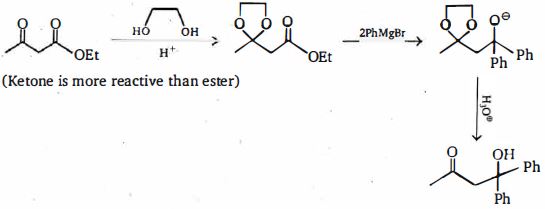
End product $(C )$ of the reaction is

- A

- ✓
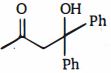
- C
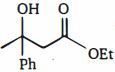
- D
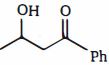
Generate a complete, print-ready paper with questions like this in minutes — across 16+ boards, with answer keys.
is an example of which of the following types of reactions
$\mathrm{Sn}(\mathrm{s})\left|\mathrm{Sn}^{2+}(\mathrm{aq}, 1 \mathrm{M}) \| \mathrm{Pb}^{2+}(\mathrm{aq}, 1 \mathrm{M})\right| \mathrm{Pb}(\mathrm{s})$
the ratio $\frac{\left[\mathrm{Sn}^{2+}\right]}{\left[\mathrm{Pb}^{2+}\right]}$ when this cell attains equilibrium is
(Given $\mathrm{E}_{\mathrm{Sn}^{2+} / \mathrm{Sn}}^{0}=-0.14 \mathrm{\;V}$ $\left.\mathrm{E}_{\mathrm{Pb}^{+2}/{\mathrm{Pb}}}^{0}=-0.13 \;\mathrm{V}, \frac{2.303 \mathrm{RT}}{\mathrm{F}}=0.06\right)$
| $Pb ^{2+} / Pb$ | $-0.13 V$ |
| $Ni ^{2+} / Ni$ | $-0.24 V$ |
| $Cd ^{2+} / Cd$ | $-0.40 V$ |
| $Fe ^{2+} / Fe$ | $V-0.44 V$ |
To a solution containing $0.001 M$ of $X ^{2+}$ and $0.1 M$ of $Y ^{2+}$, the metal rods $X$ and $Y$ are inserted (at $298 K$ ) and connected by a conducting wire. This resulted in dissolution of $X$. The correct combination(s) of $X$ and $Y$, respectively, is (are)
(Given: Gas constant, $R =8.314 J K ^{-1} mol ^{-1}$,
Faraday constant, $F =96500 C mol ^{-1}$ )
$(A)$ $Cd$ and $Ni$ $(B)$ $Cd$ and $Fe$ $(C)$ $Ni$ and $Pb$ $(D)$ $Ni$ and $Fe$