MCQ
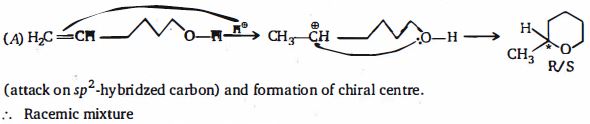
End product formed in the above reaction is

  • A
    Optically active
  • Racemic
  • C
    Meso
  • D
    Diastereomer

Answer

Correct option: B.
Racemic
b

Need a full question paper?

Generate a complete, print-ready paper with questions like this in minutes — across 16+ boards, with answer keys.

Start Generating Free

Similar questions

Which one is wrong in the following statements
A surface ejects electrons when hitted by green light but not. When hitted by yellow light. Will electrons be ejected if the surface is hitted by red light :
The relative reactivity of $1\,^oH, 2\,^oH$ and $3\,^oH$ in bromination reaction has been found to be $1 : 82 : 1600$ respectively. In the reaction

$\begin{array}{*{20}{c}}
  {C{H_3}\,\,\,\,\,\,\,\,\,\,\,\,\,\,\,\,\,\,\,\,\,\,\,\,\,\,\,\,\,\,\,\,\,\,\,\,\,\,\,\,\,\,\,} \\ 
  {|\,\,\,\,\,\,\,\,\,\,\,\,\,\,\,\,\,\,\,\,\,\,\,\,\,\,\,\,\,\,\,\,\,\,\,\,\,\,\,\,\,\,\,\,\,\,\,\,\,} \\ 
  {C{H_3} - CH - C{H_3}(excess) + B{r_2}\xrightarrow{{hv}}} 
\end{array}$ $\mathop {\begin{array}{*{20}{c}}
  {\,\,\,\,\,C{H_3}} \\ 
  | \\ 
  {C{H_3} - C - C{H_3}} \\ 
  | \\ 
  {\,\,Br} 
\end{array}}\limits_{(A)} $   +   $\mathop {\begin{array}{*{20}{c}}
  {C{H_3}\,\,\,\,\,\,\,\,\,\,} \\ 
  {\,\,|\,\,\,\,\,\,\,\,\,\,\,\,\,\,\,\,\,\,\,} \\ 
  {C{H_3} - CH - C{H_2} - Br} 
\end{array}}\limits_{(B)} $ 

the percentage yields of the products $(A)$ and $(B)$ are expected to be
The ammonia prepared by treating ammonium sulphate with calcium hydroxide is completely used by $\mathrm{NiCl}_2 .6 \mathrm{H}_2 \mathrm{O}$ to form a stable coordination compound. Assume that both the reactions are $100 \%$ complete. If $1584 \mathrm{~g}$ of ammonium sulphate and $952 \mathrm{~g}$ of $\mathrm{NiCl}_2 \cdot 6 \mathrm{H}_2 \mathrm{O}$ are used in the preparation, the combined weight (in grams) of gypsum and the nickelammonia coordination compound thus produced is $\qquad$ (Atomic weights in $\mathrm{g} \mathrm{mol}^{-1}: \mathrm{H}=1, \mathrm{~N}=14, \mathrm{O}=16, \mathrm{~S}=32, \overline{\mathrm{Cl}=35.5}, \mathrm{Ca}=40, \mathrm{Ni}=59$ )
The major product obtained when $B{r_2}/Fe$ is treated with is
Molar concentration $(M)$ of any solution $=$
Among the following the pair in which the two species are not isostructural is
Incorrect statements among the following is/are
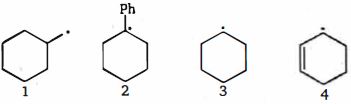
Rank the following alkyl radicals in order of increasing stability (least $< < <$ most).
The incorrect stability order of $+3$ and $+1$ states of $13^{th}$ group elements (boron family) is