Question
Endothermic reaction

Answer

Endothermic reaction: The reaction in which heat is absorbed is called an endothermic reaction.
when $KNO _{3( s )}$ dissolves in water, there is absorption of heat during the reaction and the temperature of the solution falls.
$
KNO _{2( s )}+ H _2 O _{( l )}+\text { Heat } \rightarrow KNO _{3( aq )}
$

Need a full question paper?

Generate a complete, print-ready paper with questions like this in minutes — across 16+ boards, with answer keys.
Start Generating Free

Similar questions

Calculate the amount of heat required to convert 15 g of water at 100 °C into steam. (Specific latent heat of vaporization of water = 540 cal/g)
Identify the type of disaster. 
(a) Terrorism (b) Soil erosion (c) Hepatitis (d) Forest fire (e) Famine (f) Theft
Which fuel is used in thermal power plant? Write any two problems associated with this type of power generation.
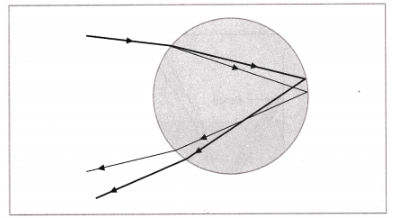
Observe the given figure and answer the following questions. (Practice Activity Sheet – 3)
Image

(a) Identify and write the natural process shown in the figure.
(b) List the phenomena which are observed in this process.
(c) Redraw the diagram and show the above phenomena in it.
What is the contribution of India in space technology?
i. Write two sources of lipids.
ii. How much energy is obtained from lipids?
iii. What is produced after digestion of lipids?
An object thrown vertically upwards reaches a height of $500 m$ . What was its initial velocity? How long will the object take to come back to the earth? Assume $g =10 m / s ^2$.
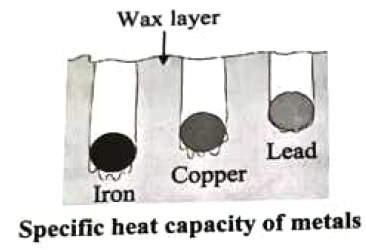
Observe the following figure and answer the questions:
Image

i. Which element has maximum specific heat capacity? Justify.
ii. Which element has minimum specific heat capacity? Justify.
iii. Define specific heat of object.
How far should an object be placed from the pole of a converging mirror of focal length 20cm to form a real image of the size exactly$\frac{1}{4}$ th the size of the object?
The diverging lens in part (a) is replaced by a converging lens also of focal length 100mm. The object remains in the same position and an image is formed by the converging lens. Compare two properties of this image with those of the image formed by the diverging lens in part (a).