Energy is not carried by which of the following waves
AIIMS 1998,AIIMS 1999, Easy
Download our app for free and get started
(a)Energy is not carried by stationary waves

Download our appand get started for free
Experience the future of education. Simply download our apps or reach out to us for more information. Let's shape the future of learning together!No signup needed.*
Similar Questions
- 1Two trains, one coming towards and another going away from an observer both at $4\; m/s$ produce whistle simultaneously of frequency $300 \;Hz$. Find the number of beats producedView Solution
- 2The displacement of the interfering light waves are ${y_1} = 4\sin \omega \,t$ and ${y_2} = 3\sin \left( {\omega \,t + \frac{\pi }{2}} \right)$. What is the amplitude of the resultant waveView Solution
- 3Two pulses travel in mutually opposite directions in a string with a speed of $2.5 cm/s$ as shown in the figure. Initially the pulses are $10cm$ apart. What will be the state of the string after two secondsView Solution
- 4A tuning fork gives $4$ beats with $50 cm$ length of a sonometer wire. If the length of the wire is shortened by $1 cm$, the number of beats is still the same. The frequency of the fork isView Solution
- 5View SolutionIn stationary waves all particles between two nodes pass through the mean position
- 6A man fires a bullet standing between two cliffs. First echo is heard after $3$ seconds and second echo is heard after $ 5$ seconds. If the velocity of sound is $330 m/s$, then the distance between the cliffs is .... $m$View Solution
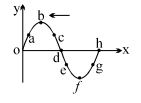
- 7The figure represents the instantaneous picture of a transverse harmonic wave traveling along the negative $x$-axis. Choose the correct alternative $(s)$ related to the movement of the nine points shown in the figure. The points moving upward is/areView Solution
- 8If velocity of a galaxy relative to earth is $1.2 \times 10^6 \,ms^{-1}$ then $\%$ increase in wavelength of light from galaxy as compared to the similar source on earth will be ...............$\%$View Solution
- 9An engine moving away from a vertical cliff blows a horn at a frequency $f$. Its speed is $0.5 \%$ of the speed of sound in air. The frequency of the reflected sound received at the engine is ............ $f$View Solution
- 10An organ pipe $P_1$ closed at one end vibrating in its first overtone. Another pipe $P_2$ open at both ends is vibrating in its third overtone. They are in a resonance with a given tuning fork. The ratio of the length of $P_1$ to that of $P_2$ isView Solution