Question
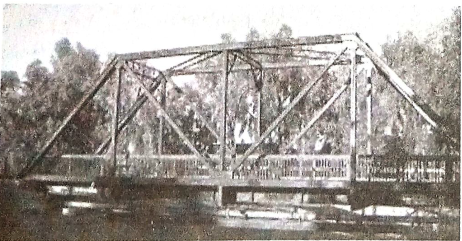
Engineers often use the familiar triangular shape for strength in bridge design. Triangles are effective tools for architecture and are used in the design of bridges, buildings and other structures as they provide strength and stability. The triangle is common in all sorts of building supports and trusses. Following are some questions on triangles:
Image
(i) In triangles ABC and DEF, if AB = DE, AC = EF and $\angle A=\angle E$. Then,
(a) $\triangle A B C \cong \triangle D E F$ by SAS criterion $\quad$(b) $\triangle A B C \cong \triangle E F D$ by SSS criterion
(c) $\triangle A B C \cong \triangle E D F$ by SAS criterion $\quad$(d) $\triangle A B C \cong \triangle E D F$ by ASA criterion
(ii) If $\triangle P R Q \cong \triangle D E F$, then $D E=$
(a) PR $\quad$(b) RQ $\quad$(c) PQ $\quad$(d) DF
(iii) Is it possible to construct a triangle with lengths of sides as 5 cm, 4 cm and 10 cm ?
(iv) In triangles ABC and DEF, AB = FD and $\angle A=\angle D$. Then the two triangles will be congruent by SAS axiom, if
(a) BC = EF $\quad$(b) AC = DE $\quad$(c) AC = EF $\quad$(d) BC = DE
Answer

(i) (c): In $\triangle^{\prime} s A B C$ and DEF, we have
$A B=D E, \angle A=\angle F \text { and } A C=E F$
So, by $S A S$ congruence criterion $\triangle A B C \cong \triangle E D F$.
(ii) (a): $\triangle P R Q \cong \triangle D E F \Rightarrow P R=D E$
(iii) No, sum of any two sides must be greater than the third side.
(iv) (b): $\triangle A B C \cong \triangle F D E$ by SAS criterion
$\therefore \quad A C=D E$

Need a full question paper?

Generate a complete, print-ready paper with questions like this in minutes — across 16+ boards, with answer keys.

Start Generating Free

Similar questions

Read the following text carefully and answer the questions that follow:
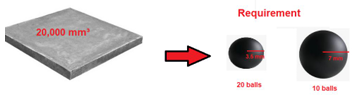
In Agra in a grinding mill, there were installed $5$ types of mills. These mills used steel balls of radius $5 \ mm, 7\ mm , 10 \ mm, 14 \ mm$ and $16 \ mm$ respectively. All the balls were in the spherical shape.
For repairing purpose mills need $10 $ balls of $7\ mm$ radius and $20 $ balls of $3.5\ mm$ radius. The workshop was having $20000\ mm^3$ steel. This $20000 \ mm^3$ steel was melted and $10$ balls of $7\ mm$ radius and $20$ balls of $3.5\ mm$ radius were made and the remaining steel was stored for future use.
Image
$i$. What was the volume of one ball of $3.5\ mm$ radius?
$ii$. What was the surface area of one ball of $3.5\ mm$ radius?
$iii$. What was the volume of $10$ balls of radius $7\ mm$?
OR
How much steel was kept for future use?
Read the Source Text given below and answer these questions:
A teacher is a person whose professional activity involves planning, organizing, and conducting group activities to develop students’ knowledge, skills, and attitudes as stipulated by educational programs. Teachers may work with students as a whole class, in small groups or one$-$to$-$one, inside or outside regular classrooms. In this indicator, teachers are compared by their average age and work experience measured in years.
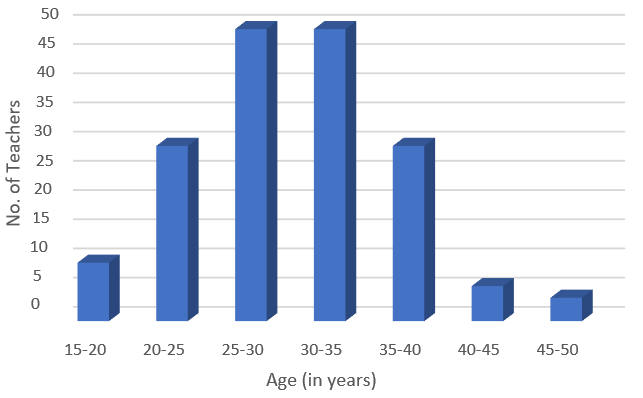
For the same in $2015,$ the following distribution of ages $($in years$)$ of primary school teachers in a district was collected to evaluate the teacher on the above$-$mentioned criterion.

$i.$ Write the lower limit of the first$-$class interval:
$a. 15$
$b. 20$
$c. 17.5$
$d. 5$
$ii.$ Determine the class limits of the fourth class interval:
$a. 25-30$
$b. 30-35$
$c. 40-45$
$d. 45-50$
$iii.$ Find the class mark of class $45-50:$
$a. 45.5$
$b. 47.5$
$c. 54.5$
$d. 55.5$
$iv.$ Determine the class size:
$a. 4$
$b. 5.5$
$c. 5$
$d. 6$
$v. $Facts or figures collected with a definite purpose are called $..........$
$a.$ Data.
$b.$ Sample.
$c.$ Information.
$d.$ Statistics.
Read the Source/ Text given below and answer these questions:

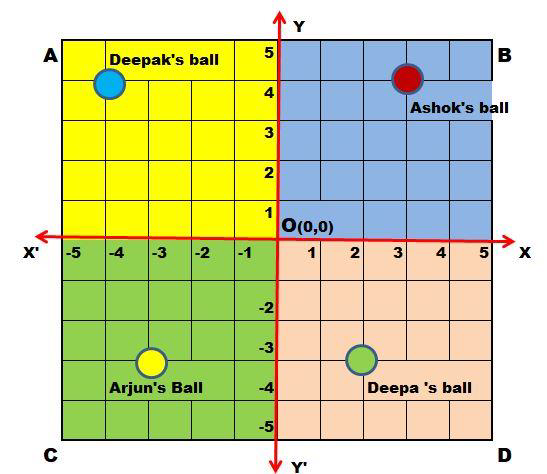
There is a square park $\text{ABCD}$ in the middle of Saket colony in Delhi.Four children Deepak, Ashok, Arjun and Deepa went to play with their balls. The colour of the ball of Ashok, Deepak, Arjun and Deepa are red, blue, yellow and green respectively. All four children roll their ball from centre point $O$ in the direction of $XOY, X'OY, X'OY'$ and $XOY'.$ Their balls stopped as shown in the above image. Answer the following questions:
$i.$ What are the coordinates of the ball of Ashok$?$
$a. (4, 3)$
$b. (3, 4)$
$c. (4, 4)$
$d. (3, 3)$
$ii.$ What are the coordinates of the ball of Deepa$?$
$a. (2, -3)$
$b. (3, 2)$
$c. (2, 3)$
$d. (2, 2)$
$iii.$ What the line $\text{XOX'}$ is called$?$
$a. y-$axis.
$b.$ ordinate.
$c. x-$axis.
$d.$ origin.
$iv.$  What the point $O(0, 0)$ is called$?$
$y-$axis.
ordinate.
$x-$axis.
origin.
$v.$ What is the ordinate of the ball of Arjun$?$
$a. -3$
$b. 3$
$c. 4$
$d. 2$
Read the Source/ Text given below and answer these questions:

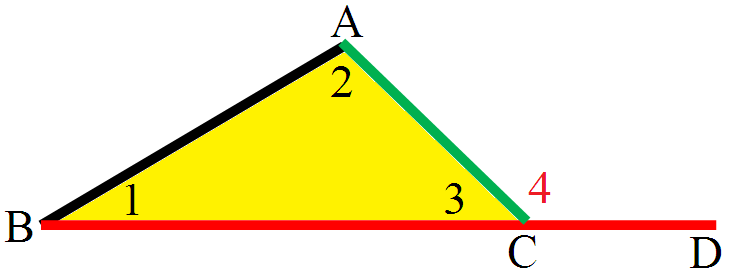
Ashok is studying in $9^{th}$ class in Govt School, Chhatarpur. Once he was at his home and was doing his geometry homework. He was trying to measure three angles of a triangle using the Dee, but his dee was old and his Dee's numbers were erased and the lines on the dee were visible. Let us help Ashok to find the angles of the triangle. He found that the second angle of the triangle was three times as large as the first. The measure of the third angle is double of the first angle. Now answer the following questions:
$i.$ What was the value of the first angle$?$
$a. 30^\circ $
$b. 45^\circ $
$c. 60^\circ $
$d. 90^\circ $
$ii.$ What was the value of the third angle$?$
$a.30^\circ $
$b.45^\circ $
$c.60^\circ $
$d. 90^\circ $
$iii.$ What was the value of the second angle$?$
$a.30^\circ $
$45^\circ $
$c.60^\circ $
$d. 90^\circ $
$iv.$ What was the value of $\angle4$ as shown the figure$?$
$a.120^\circ $
$b.45^\circ $
$c.60^\circ $
$d. 90^\circ $
$v.$  What was the sum of all three angles measured by Ashok using Dee$?$
$a.270^\circ $
$b.180^\circ $
$c.100^\circ $
$d. 90^\circ $
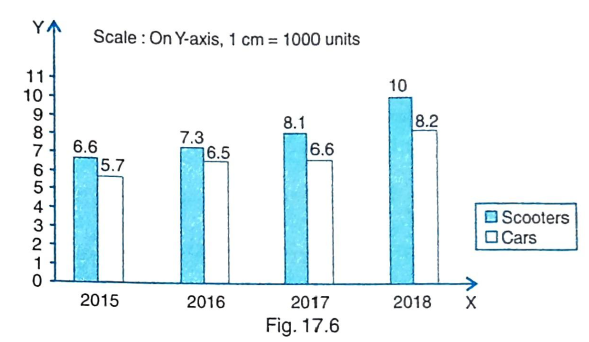
Read the following bar graph and answer the following questions:
Image
(i) In which year was the difference between the sales of the scooters and the sales of cars the least?
(a) 2015(\quad$ (b) 2016(\quad$ (c) 2017(\quad$ (d) 2018
(ii) Total number of vehicles (scooters and cars) sold in the year 2015 and 2016 was
(a) 26,100$\quad$ (b) 28,500$\quad$ (c) 25,100$\quad$ (d) 27,500
(iii) The maximum difference between the sales of scooters and cars, in any year, in the given period was
(a) 1500$\quad$ (b) 1700$\quad$ (c) 1800$\quad$ (d) 2000
(iv) The total number of scooters sold in the four years was
(a) 26,000$\quad$ (b) 27,000$\quad$ (c) 31,000$\quad$ (d) 32,000
(v) The ratio between the total number of vehicles sold (scooters and cars) in the year 2016 and that in the year 2018.
(a) 41:46$\quad$ (b) 69:91$\quad$ (c) 147:182$\quad$ (d) 46:49
A soap manufacturer makes fragrant and non-fragrant liquid soaps. The liquid soaps are illed in plastic bottles and packed in equal size cartons for transportation. Each carton contains $50$ bottles. The mass of a full bottle of soap is $220\ gm$ and that of a half$-$illed bottle is $120\ gm.$ What will be the mass $(gm)$ of the empty bottle$?$
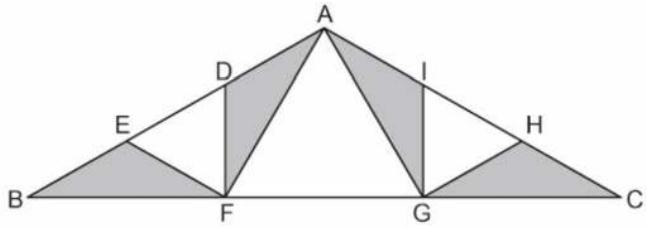
The figure below consists of a square and an equilateral triangle connected together with a
common side.
Image

In the design, $DF$ and $IG$ are two iron rods perpendicular to $BC.$ The measure of $\angle BAC = 120^\circ .$
$8.$ Which type of triangle is $ABC?$ Why$?$
$9.$ The central triangle AFG is equilateral. What is the measure of $\angle FDA?$
$A. 30^\circ $
$B. 60^\circ $
$C. 90^\circ $
$D. 120^\circ $
$10.$ The length of $IG$ is half of the length of $GC$. Write a proof for the statement.
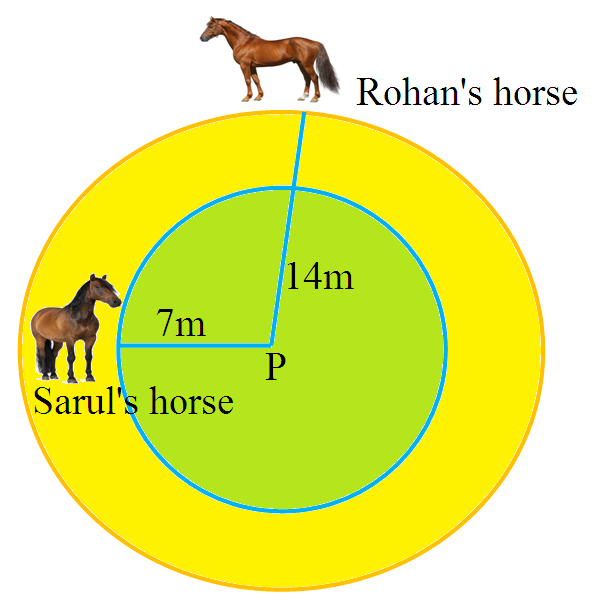
Read the Source/ Text given below and answer any four questions: Rohan and Suraj were close friends, One day they were riding horses from Delhi to Faridabad. The names of their horses were Saku and Fareed respectively. The day was very sunny. On the way, they stopped for resting in a park. They tied their horses to a tree in the park. The length of ropes of Rohans's horse is $14m$ and that of the horse of Suraj is $7m$ as shown in the figures. Both the friends slept in the park under a green tree for some time. During this period both the horses took $10$ rounds along with the tree they were tied.

Answer the following questions
$i.$ The ratio of distance walked in $10$ rounds by the horses of Rohan and Suraj is:
$a. 2 : 1$
$b. 1 : 2$
$c. 3 : 1$
$d. 1 : 3$
$ii.$ The ratio of area of the grass the horses of Rohan and Suraj could graze:
$a. 2 : 1$
$b. 1 : 2$
$c. 4 : 1$
$d. 1 : 4$
$iii.$ What is the distance walked by Rohan's horse in $5$ rounds:
$a. 220\ m$
$b. 100\ m$
$c. 440\ m$
$d. 110\ m$
$iv.$ What we call the the length of rope in terms of circle$?$
$a.$ Diameter
$b.$ Radius
$c.$ Chord
$d.$ Tangent
$v.$ What we call the the distance walked by a horse in one round$?$
$a.$ Area
$b.$ Radius
$c.$ Circumference
$d.$ diameter
Read the following text carefully and answer the questions that follow:
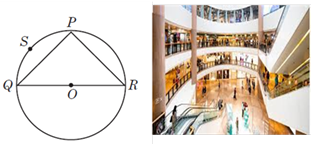
Sanjay and his mother visited in a mall. He observes that three shops are situated at $P, Q, R$ as shown in the figure from where they have to purchase things according to their need. Distance between shop $P$ and $Q$ is $8 m$ and between shop $P$ and $R$ is $6 m$.
Considering $O$ as the center of the circles.
Image
$i$. Find the Measure of $\angle QPR$.
$ii$. Find the radius of the circle.
$iii$. Find the Measure of $\angle QSR$.
OR
Find the area of $\Delta PQR$.
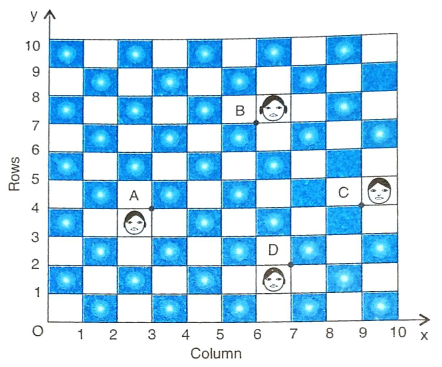
Four persons John, Saurabh, Salim and Ratan are sitting in a courtyard at points A, B, C and D respectively as shown in Fig. The courtyard has been divided into small squares by drawing equally spaced horizontal and vertical lines. Taking OX and OY as the coordinates axes answer the following questions:
Image
(i) The distance between John and Salim is
(a) 6 units $\quad$(b) 4 units $\quad$(c) 5 units $\quad$(d) 7 units
(ii) The distance between John and Saurabh is
(a) 6 units $\quad$(b) $3 \sqrt{2}$ units $\quad$(c) $6 \sqrt{2}$ units $\quad$(d) $2 \sqrt{2}$ units
(iii) The distance between John and Ratan is
(a) $2 \sqrt{5}$ units $\quad$(b) $2 \sqrt{10}$ units $\quad$(c) $\sqrt{5}$ units $\quad$(d) 20 units
(i) The coordinates of point A are
(a) $(4,3)$ $\quad$(b) $(3,4)$ $\quad$(c) $(3,3)$ $\quad$(d) $(4,4)$