Question
Enlist three types of muscles with their locations.

Answer

  1. Striated Muscles: It occur in the muscles of limbs, body wall, face, neck, etc. Striated muscles present in tongue, pharynx, diaphragm and upper part of oesophagus are called visceral straited muscles.
  2. Smooth Muscles: Smooth muscles are found in the walls of the hollow (tubular) visceral organs except that of the heart. They occur in the wall of alimentary canal and internal organs, ducts of glands, urogenital ducts and blood vessels.
  3. Cardiac Muscles: The cardiac muscles occur in the heart.

Need a full question paper?

Generate a complete, print-ready paper with questions like this in minutes — across 16+ boards, with answer keys.
Start Generating Free

Similar questions

A piece of stone is thrown vertically upwards. It reaches the maximum height in $3$ seconds. If the acceleration of the stone be $9.8\ m/s^2$ directed towards the ground, calculate the initial velocity of the stone with which it is thrown upwards.
A piece of chalk can be broken into small particles on hammering, but it is not possible to break a piece of iron in the same fashion. Why?
Describe how the gravitational force between two objects depends on the distance between them.
A sample of water under study was found to boil at 102°C at normal pressure. Is the water pure? Will this water freeze at 0°C? Comment.
Why are leguminous crops desirable in crop rotation?
A truck of mass $500\ kg$ moving at $4\ m/s$ collides with another truck of mass $1500\ kg$ moving in same direction at $2\ m/s.$ What is their common velocity just after collision, if they move off together?
The substance X normally exists in a physical state which can flow easily but does not fill its vessel completely. It also turns anhydrous copper sulphate blue. When substance X is cooled excessively, it changes into a substance Y which has a fixed shape as well as a fixed volume. If, however, the substance X is heated strongly, it changes into a substance Z which has neither a fixed shape nor a fixed volume.
  1. Name the substances (i) X (ii) Y and (iii) Z.
  2. What is the process of conversion of X into Y known as?
  3. At which temperature X gets converted into Y?
  4. What is the process of conversion of X into Z known as?
  5. At which temperature X gets converted into Z?
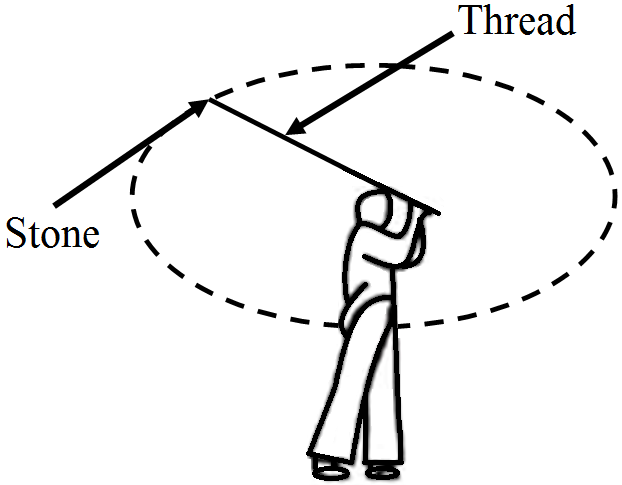
Look at the figure below and answer the following questions:
  1. Name the kind of motion of the stone.
  2. It this an example of accelerated motion? Why?
  3. Name the force that keeps the stone in its path.
  4. What is the direction of this force? Draw it in your answer sheet.
Find the momentum of a body of mass 100g having a kinetic energy of 20J.
How would you obtain sodium chloride from a mixture of sodium chloride and sulphur without using water?