Question
Enumerate the reactions of D - glucose which cannot be explained by its open chain structure.

Answer

  1. D (+) - glucose does not undergo certain characteristic reactions of aldehydes, e.g., glucose does not form NaHSOaddition product.
  2. Glucose reacts with NH2OH to form an oxime but glucose pentaacetate does not. This implies that the aldehydic group is absent in glucose pentaacetate.
  3. D - (+) - glucose exists in two stereoisomeric forms, i.e., $\alpha$ - glucose and $\beta$ - glucose.
  4. Both $\alpha$ - D - glucose and $\beta$ - D - glucose undergo mutarotation in aqueous solution. Although the crystalline forms of  $\alpha$ - and  $\beta$ - D (+) - glucose are quite stable in aqueous solution but each form slowly changes into an equilibrium mixture of both.

D (+) - glucose forms two isomeric methyl glucosides. Aldehydes normally react with two moles of methanol per mole of the aldehyde to form an acetal but D (+) - glucose when treated with methanol in presence of dry HCI gas, reacts with only one mole of methanol per mole of glucose to form a mixture of two methyl D - glucosides i.e., methyl - $\alpha$ - D - glucoside (melting point 438 K, specific rotation + 158°) and methyl - $\beta$ - D - glucoside (melting point 308 K, specific rotation - 33°).

Need a full question paper?

Generate a complete, print-ready paper with questions like this in minutes — across 16+ boards, with answer keys.

Start Generating Free

Similar questions

The ratio of amount of $Al , Cu$ and Na obtained at the cathode by passing 3 Faraday electric current in different electrolytic cell filled with aqueous solution of molten $AlCl _3, CuSO _4$ and molten NaCl . What be the ratio of amounts of $Al , Cu$ and Na ?
Chlorobenzene is extremely less reactive towards a nucleophilic substitution reaction. Give two reasons for the same.
Write chemical reaction for the preparation of phenol from chlorobenzene.
Match the items of Column I and Column II
  Column I   Column II
(i) SN1 reaction (a) vic-dibromides
(ii) Chemicals in fire extinguisher (b) gem-dihalides
(iii) Bromination of alkenes (c) Racemisation
(iv) Alkylidene halides (d) Saytzeff rule
(v) Elimination of HX from alkylhalide (e) Chlorobromocarbons
On what factors do the products obtained from electrolysis a solution of an electrolyte depend?
A graph between ln k and $\frac{1}{\text{t}}$ for a reaction is given. Here k is rate constant and T is temperature in Kelvin.

If OA = a and OB = b, answer the following:
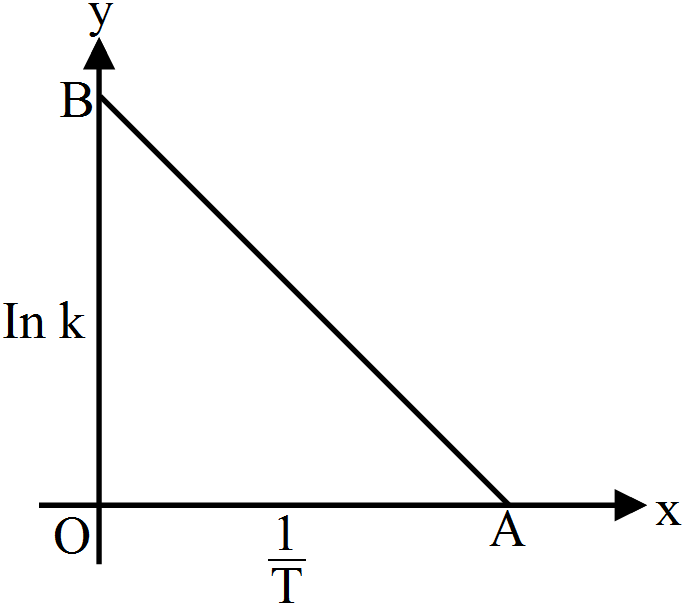
  1. What is the activation energy (Ea) of the reaction?
  2. What is the frequency factor (A) for the reaction?

What is the difference between glucose and starch?
Give plausible explanation :
During the preparation of esters from a carboxylic acid and an alcohol in the presence of an acid catalyst, the water or the ester should be removed as soon as it is formed.
Express the relation among cell constant, resistance of the solution in the cell and conductivity of the solution. How is molar conductivity of a solution related to its conductivity? 
0.05 moles of ethanoic acid is dissolved in $2 5 0 ~ g m$ benzene. Calculate molality of solution.