MCQ
Enzymes
  • A
    Accelerate biochemical reactions
  • B
    Have optimum activity at body temperature
  • C
    Consist of amino acids
  • Have all these properties

Answer

Correct option: D.
Have all these properties
d
Enzymes:

$(i)$ Are proteins that catalyze the biochemical reactions

$(ii)$ They consist of amino acids.

$(iii)$ Have optimum activity at body temperature.

Therefore, optimal temperature is usually around human body temperature $\left(37.5^{\circ} C \right)$

Need a full question paper?

Generate a complete, print-ready paper with questions like this in minutes — across 16+ boards, with answer keys.
Start Generating Free

Similar questions

$1000\,gms$ aqueous solution of $CaC{O_3}$ contains $10\,gms$  of carbonate. Concentration of the solution is .......... $ppm$.
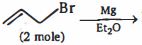
Predict major product of the reaction
The magnetic moment is measured in Bohr Magneton (BM).

Spin only magnetic moment of $Fe$ in $\left[ Fe \left( H _2 O \right)_6\right]^{3+}$ and $\left[ Fe ( CN )_6\right]^{3-}$ complexes respectively is:

In which case van't Hoff factor is maximum (assuming no hydrolysis)?
A $0.5\,M\,NaOH$ solution offers a resistance of $31.6\,ohm$ in a conductivity cell at room temperature. What shall be the approximate molar conductance of this $NaOH$ solution if cell constant of the cell is $0.367\,cm^{-1}$. ............ ${\rm{S}}\,{\rm{c}}{{\rm{m}}^2}{\rm{mo}}{{\rm{l}}^{ - 1}}$
Which of the following statement($s$) is(are) true ?

$(1)$ Oxidation of glucose with bromine water gives glutamic acid

$(2)$ The two six-membered cyclic hemiacetal forms of $D-(+)$-glucose ard called anomers

$(3)$ Hydrolysis of sucrose gives dextrorotatory glucose and laevorotatory fructose

$(4)$ Monosaccharides cannot be hydrolysed to give polyhydroxy aldehydes and ketones

What is ${E^o}$ for electrode represented by $Pt,\,{O_2}(1\,atm)\,/\,2{H^ + }({\mathop{\rm 1\,m}\nolimits} )$ ............. $\mathrm{V}$
In the following sequence of reactions :

Toluene $\xrightarrow{{KMn{O_4}}}A\xrightarrow{{SOC{l_2}}}$ $B\xrightarrow[{BaS{O_4}}]{{{H_2}/Pd}}C$

the product $C$ is :

An organic liquid A containing $C,H$ and  $O$  has a pleasant odour with a boiling point of ${78\,^o}C$ On boiling A with conc. ${H_2}S{O_4}$ a colourless gas is produced which decolourises bromine water and alkaline $KMn{O_4}.$ One mole of this gas also takes one mole of ${H_2}.$ The organic liquid $ A$  is
A $500\,g$ tooth paste sample has $0.2\,g$ fluoride concentration. What is the concentration of $F$ in terms of $ppm$ level