- vA > vB
- vA = vB
- vA < vB
- The relation depends on the actual magnitude of the torques.
Explanation:
$\tau=\text{I}\alpha$ (Magnitude)
For equal torque, we have:
$\text{I}_{\text{A}\propto\text{A}}=\text{I}_{\text{B}\propto\text{B}}$
$\text{I}_{\text{A}}<\text{I}_{\text{B}}$
$\Rightarrow\alpha_{\text{A}}>\alpha_{\text{B}}\ \dots(\text{i})$
Now, $\omega=\alpha\text{t}$
Or, $\frac{\text{v}}{\text{r}}=\alpha\text{t}$
$\text{v}_{\text{A}}>\text{v}_{\text{B}}$ [Using (i)]
Generate a complete, print-ready paper with questions like this in minutes — across 16+ boards, with answer keys.
A parallel plate capacitor has a capacity C. The separation between the plates is doubled and a dielectric medium is introduced between the plates. If the capacity now becomes 2C, the dielectric constant of the medium is
|
(a) 2 |
(b) 1 |
(c) 4 |
(d) 8 |
The work function of a metal is 4.2 eV, its threshold wavelength will be
|
(a) 4000 Å |
(b) 3500 Å |
(c) 2955 Å |
(d) 2500 Å |
The electrochemical equivalent Z of any element can be obtained by multiplying the electrochemical equivalent of hydrogen with
|
(a) Atomic weight |
(b) Molecular weight |
(c) Chemical equivalent |
(d) A constant |
In the figure is shown Young’s double slit experiment. Q is the position of the first bright fringe on the right side of O. P is the 11th fringe on the other side, as measured from Q. If the wavelength of the light used is 6000 , then
will be equal to
|
(a) 6 |
(b) 6.6 |
(c) 3.138 |
(d) 3.144 |
Two lenses of power 6D and – 2D are combined to form a single lens. The focal length of this lens will be
|
(a) |
(b) |
(c) 4 m |
(d) |
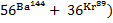
The number of neutrons released when
undergoes fission by absorbing
and (
are formed, is
|
(a) 0 |
(b) 1 |
(c) 2 |
(d) 3 |
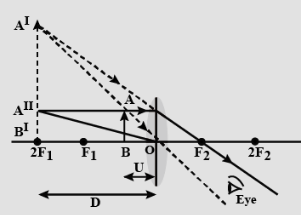
Figure shows the ray diagram of a: