MCQ
Equation $\frac{1}{r} = \frac{1}{8} + \frac{3}{8}\cos \theta $ represents
  • A
    A rectangular hyperbola
  • A hyperbola
  • C
    An ellipse
  • D
    A parabola

Answer

Correct option: B.
A hyperbola
b
(b) Given, equation is $\frac{1}{r} = \frac{1}{8} + \frac{3}{8}\,\cos \theta $

or $\frac{8}{r} = 1 + 3\cos \theta $

which is the form of $\frac{l}{r} = 1 + e\cos \theta $

$\because \,e = 3 > 0$,

$\therefore \,$ Given equation is a hyperbola.

Need a full question paper?

Generate a complete, print-ready paper with questions like this in minutes — across 16+ boards, with answer keys.
Start Generating Free

Similar questions

If the foci of a hyperbola are same as that of the ellipse $\frac{x^2}{9}+\frac{y^2}{25}=1$ and the eccentricity of the hyperbola is $\frac{15}{8}$ times the eccentricity of the ellipse, then the smaller focal distance of the point $\left(\sqrt{2}, \frac{14}{3} \sqrt{\frac{2}{5}}\right)$ on the hyperbola, is equal to
If $a,\,b,\,c,\,d$ are positive real numbers such that $a + b + c + d$ $ = 2,$ then $M = (a + b)(c + d)$ satisfies the relation
The sum of the infinite series $1+\frac{5}{6}+\frac{12}{6^{2}}+\frac{22}{6^{3}}+\frac{35}{6^{4}}+\frac{51}{6^{5}}+\frac{70}{6^{6}}+\ldots .$ is equal to
The locus of a point which moves in such a way that its distance from $(0,0)$ is three times its distance from the $x$-axis, as given by
Let a point $P$ be such that its distance from the point $(5,0)$ is thrice the distance of $P$ from the point $(-5,0) .$ If the locus of the point $P$ is a circle of radius $r$, then $4 r ^{2}$ is equal to ...... .
In the expansion of ${\left( {{x^2} - 2x} \right)^{10}}$, the coefficient of ${x^{16}}$ is
If $y=y(x)$ is the solution of the differential equation $\frac{d y}{d x}+2 y=\sin (2 x), y(0)=\frac{3}{4},$ then $y \left(\frac{\pi}{8}\right)$ is equal to :
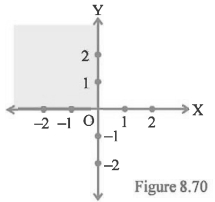
The coloured region in figure 8.70 is the solution set of $\ldots . . . .$
The interval of $x$ in which the inequality ${5^{(1/4)(\log _5^2x)}}\, \geqslant \,5{x^{(1/5)(\log _5^x)}}$
If $z = \frac{{\sqrt 3 }}{2} + \frac{i}{2}\,\,\,\left( {i = \sqrt { - 1} } \right)$, then ${\left( {1 + iz + {z^5} + i{z^8}} \right)^9}$ is equal to