MCQ
Equation of a stationary wave is $y = 10\sin \frac{{\pi x}}{4}\cos 20\pi\, t.$ Distance between two consecutive nodes is
  • $4$
  • B
    $2$
  • C
    $1$
  • D
    $8$

Answer

Correct option: A.
$4$
a
(a) On comparing the given equation with standard equation $\frac{{2\pi }}{\lambda } = \frac{\pi }{4} \Rightarrow \lambda = 8$
Hence distance between two consecutive nodes $\frac{\lambda }{2} = 4$

Need a full question paper?

Generate a complete, print-ready paper with questions like this in minutes — across 16+ boards, with answer keys.
Start Generating Free

Similar questions

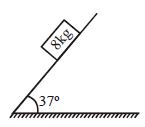
A block of mass $8\, kg$ is at rest on a rough inclined plane as shown in figure. The magnitude of net force exerted by the surface on the block will be ......... $N$
The molecular kinetic energy of a liquid is:
A block of mass $m$ moving with speed $v$ compresses a spring through distance $x$ before its speed is halved. What is the value of spring constant ?
If the breaking force for a given wire is $F$, then the breaking force of two wires of same magnitude will be
A stationary rocket of initial mass $m_0$ is expelling exhaust gas at a steady speed $v$. with respect to itself There is no external force on rocket. When its mass is reduced to $\frac{{{m_0}}}{2}$ , the velocity attained by rocket will be
At temperature $T,$ the $r.m.s.$ speed of helium molecules is the same as $r.m.s.$ speed of hydrogen molecules at normal temperature and pressure. The value of $T$ is  ....... $^oC$
The wettability of a surface by a liquid depends primarily on
The temperature of a metal coin is increased by $100^{\circ} C$ and its diameter increases by $0.15 \%$. Its area increases by nearly
When torque applied on a system is zero, which of the following will be constant?
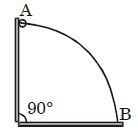
A wire, which passes through the hole in a small bead, is bent in the form of quarter of a circle. The wire is fixed vertically on ground as shown in the figure. The bead is released from near the top of the wire and it slides along the wire without friction. As the bead moves from $A$ to $B$, the force it applies on the wire is