MCQ
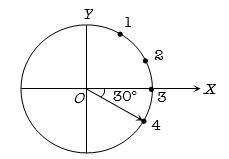
Equation of the hour hand at $4$ O’ clock is
  • A
    $x - \sqrt 3 \;y = 0$
  • B
    $\sqrt 3 \;x - y = 0$
  • $x + \sqrt 3 \;y = 0$
  • D
    $\sqrt 3 \;x + y = 0$

Answer

Correct option: C.
$x + \sqrt 3 \;y = 0$
c
(c) Since the hour, minute and second hands always pass through origin because one end of these hands is always at origin. Now at $4$ O’ clock, the hour hand makes ${30^o}$angle in fourth quadrant. So the equation of hour hand is

$y = mx \Rightarrow y = - \frac{1}{{\sqrt 3 }}x$

$ \Rightarrow x + \sqrt 3 y = 0$.
Need a full question paper?

Generate a complete, print-ready paper with questions like this in minutes — across 16+ boards, with answer keys.

Start Generating Free

Similar questions

The equation of motion of a stone thrown vertically upward from the surface of a planet is given by $s = 10\,\,t - 3{t^2}$, and the units of $s$ and $t$ are $cm$ and $sec$ respectively. The stone will return to the surface of the planet after
Let $\alpha, \beta, \gamma, \delta \in \mathrm{Z}$ and let $\mathrm{A}(\alpha, \beta), \mathrm{B}(1,0), \mathrm{C}(\gamma, \delta)$ and $D(1,2)$ be the vertices of a parallelogram $\mathrm{ABCD}$. If $\mathrm{AB}=\sqrt{10}$ and the points $\mathrm{A}$ and $\mathrm{C}$ lie on the line $3 y=2 x+1$, then $2(\alpha+\beta+\gamma+\delta)$ is equal to
Consider the following two statements:
Statement $I$ : For any two non $-$ zero complex numbers $z_1, z_2$ 
$\left(\left|z_1\right|+\left|z_2\right|\right)\left|\frac{z_1}{\left|z_1\right|}+\frac{z_2}{\left|z_2\right|}\right| \leq 2\left(\left|z_1\right|+\left|z_2\right|\right)$ 
Statement $II$ : If $x, y, z$ are three distinct complex numbers and $a, b, c$ are three positive real numbers
such that $\frac{a}{|y-z|}=\frac{b}{|z-x|}=\frac{c}{|x-y|}$ then
$\frac{a^2}{y-z}+\frac{b^2}{z-x}+\frac{c^2}{x-y}=1$
The solutions of the equation $\left|\begin{array}{ccc}1+\sin ^{2} x & \sin ^{2} x & \sin ^{2} x \\ \cos ^{2} x & 1+\cos ^{2} x & \cos ^{2} x \\ 4 \sin 2 x & 4 \sin 2 x & 1+4 \sin 2 x\end{array}\right|=0,(0< x< \pi), \operatorname{are}$
The shortest distance of the point $(a, b, c)$ from the $x$ - axis is
If the probability that the random variable $X$ takes values $x$ is given by $P ( X = x )= k ( x +1) 3^{- x }, x =0$, $1,2,3 \ldots$, where $k$ is a constant, then $P ( X \geq 2)$ is equal to
If $A\, = \,\left[ {\begin{array}{*{20}{c}}
{{e^t}}&{{e^{ - t}}\,\cos \,t}&{{e^{ - t}}\,\sin \,t}\\
{{e^t}}&{ - {e^{ - t}}\,\cos \, - {e^{ - t}}\,\sin \,t}&{ - {e^{ - t}}\,\sin \,t\, + \,{e^{ - t}}\,\cos \,t}\\
{{e^t}}&{2{e^{ - t}}\,\sin \,t}&{2{e^{ - t}}\,\cos \,t}
\end{array}} \right]$ Then $A$ is
The sum of all positive integers $n$ for which $\frac{1^3+2^3+\ldots+(2 n)^3}{1^2+2^2+\ldots+n^2}$ is also an integers is
Let $\mathrm{A}(\mathrm{a}, 0), \mathrm{B}(\mathrm{b}, 2 \mathrm{~b}+1)$ and $\mathrm{C}(0, \mathrm{~b}), \mathrm{b} \neq 0, \mathrm{|b} \mid \neq 1$ be points such that the area of triangle $\mathrm{ABC}$ is $1 \,\mathrm{sq}$. unit, then the sum of all possible values of a is :
The line $3x - 2y = k$ meets the circle ${x^2} + {y^2} = 4{r^2}$ at only one point, if ${k^2}$=