MCQ
Equation $\sqrt {{{(x - 2)}^2} + {y^2}} + \sqrt {{{(x + 2)}^2} + {y^2}} = 4$ represents
  • A
    Parabola
  • B
    Ellipse
  • C
    Circle
  • Pair of straight lines

Answer

Correct option: D.
Pair of straight lines
d
(d) Given equation is , $\sqrt {{{(x - 2)}^2} + {y^2}} + \sqrt {{{(x + 2)}^2} + {y^2}} = 4$

$\sqrt {{{(x - 2)}^2} + {y^2}} = 4 - \sqrt {{{(x - 2)}^2} + {y^2}} $

Squaring both sides, we get $\sqrt {{{(x + 2)}^2} + {y^2}} = x + 2$

Again squaring both sides, we get ${y^2} = 0$, which is the equation of pair of straight lines.

Need a full question paper?

Generate a complete, print-ready paper with questions like this in minutes — across 16+ boards, with answer keys.

Start Generating Free

Similar questions

If both the means and the standard deviation of $50$ observations $x_1, x_2, ………, x_{50}$ are equal to $16$ , then the mean of $(x_1 - 4)^2, (x_2 - 4)^2, …., (x_{50} - 4)^2$ is
Let $f$ be $a$ differentiable function on the open interval $(a, b)$. Which of the following statements must be true?

$I$. $f$ is continuous on the closed interval $[a, b]$

$II.$ $f$ is bounded on the open interval $(a, b)$

$III.$ If $a$ $< a_1< b_1< b$, and $f (a_1)<0< f (b_1)$, then there is $a$ number $c$ such that $a_1 < c < b_1$ and $f (c)=0$
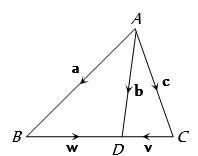
In the figure, a vector $x$  satisfies the equation $x - w = v$. Then $x =$
Point $M$ moved along the circle $(x - 4)^2 + (y - 8)^2 = 20 $. Then it broke away from it and moving along a tangent to the circle, cuts the $x-$ axis at the point $(- 2, 0)$ . The co-ordinates of the point on the circle at which the moving point broke away can be :
The value of $x$ that maximises the value of the integral $\int\limits_x^{x + 3} {t(5 - t)\,dt}$ is
Let $E$ be the ellipse $\frac{x^2}{16}+\frac{y^2}{9}=1$. For any three distinct points $P, Q$ and $Q^{\prime}$ on $E$, let $M(P, Q)$ be the mid-point of the line segment joining $P$ and $Q$, and $M \left( P , Q ^{\prime}\right)$ be the mid-point of the line segment joining $P$ and $Q ^{\prime}$. Then the maximum possible value of the distance between $M ( P , Q )$ and $M \left( P , Q ^{\prime}\right)$, as $P, Q$ and $Q^{\prime}$ vary on $E$, is. . . . .
If $\vec a\, = \,\vec i - 2\hat j + 3\hat k,\,\,\,\vec b = 2\vec i + 3\hat j - \hat k$ and $\vec c = \lambda \vec i + \hat j + (2\lambda  - 1\hat k)$ are coplanar vectors, then $\lambda $ is equal to
The integral $\int \frac{\left(x^8-x^2\right) d x}{\left(x^{12}+3 x^6+1\right) \tan ^{-1}\left(x^3+\frac{1}{x^3}\right)}$ is equal to:
If the eccentricity of the hyperbola $x^2 - y^2 \sec^2 \alpha = 5$  is $\sqrt 3 $  times the eccentricity of the ellipse $x^2 \sec^2 \alpha + y^2 = 25, $ then a value of $\alpha$  is :
If the point $\left(\alpha, \frac{7 \sqrt{3}}{3}\right)$ lies on the curve traced by the mid-points of the line segments of the lines $x$ $\cos \theta+ y \sin \theta=7, \theta \in\left(0, \frac{\pi}{2}\right)$ between the coordinates axes, then $\alpha$ is equal to