Equations ${y_1} = A\sin \omega t$ and ${y_2} = \frac{A}{2}\sin \omega t + \frac{A}{2}\cos \omega t$ represent $S.H.M.$ The ratio of the amplitudes of the two motions is
Medium
Download our app for free and get started
(d) ${y_2} = \frac{A}{2}\sin \omega \,t + \frac{A}{2}\cos \omega \,t$
${y_2} = \frac{A}{2}(\sin \omega \,t + \cos \omega \,t) = \frac{A}{2} \times \sqrt 2 \;[\sin (\omega \,t + {45^o})]$
${y_2} = \frac{A}{{\sqrt 2 }}\sin (\omega \,t + {45^o})$$ \Rightarrow \frac{{{A_1}}}{{{A_2}}} = \frac{A}{{A/\sqrt 2 }} = \sqrt 2 $

Download our appand get started for free
Experience the future of education. Simply download our apps or reach out to us for more information. Let's shape the future of learning together!No signup needed.*
Similar Questions
- 1A simple pendulum is set up in a trolley which moves to the right with an acceleration a on a horizontal plane. Then the thread of the pendulum in the mean position makes an angle $\theta $ with the verticalView Solution
- 2A pendulum suspended from the ceiling of a train oscillates with a time period $2\,second$, when the train is accelerating at $10\,ms^{-2}$. What will be its time period when the train retards at $10\,ms^{-2}$ ? ..... $\sec$View Solution
- 3If the maximum velocity and maximum acceleration of a particle executing $SHM$ are equal in magnitude, the time period will be .... $\sec$View Solution
- 4A particle executes $SHM$ of period $1.2\, sec$ and amplitude $8\, cm.$ Find the time it takes to travel $3\,cm$ from the positive extremity of its oscillation. ..... $\sec$View Solution
- 5A light balloon filled with helium of density $\rho_{ He }$ is tied to a long light string of length $l$ and the string is attached to the ground. If the balloon is displaced slightly in the horizontal direction from the equilibrium and released. Then,View Solution
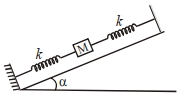
- 6In the given figure, a body of mass $M$ is held between two massless springs, on a smooth inclined plane. The free ends of the springs are attached to firm supports. If each spring has spring constant $k,$ the frequency of oscillation of given body is :View Solution
- 7The resultant of two rectangular simple harmonic motions of the same frequency and equal amplitudes but differing in phase by $\frac{\pi }{2}$ isView Solution
- 8The time period of a particle executing $S.H.M.$ is $8 \,s$. At $t=0$ it is at the mean position. The ratio of distance covered by the particle in $1^{\text {st }}$ second to the $2^{\text {nd }}$ second is .............. $s$View Solution
- 9A particle in $SHM $ is described by the displacement equation $x(t) = A\cos (\omega t + \theta ).$ If the initial $(t = 0)$ position of the particle is $1 \,cm$ and its initial velocity is $\pi $cm/s, what is its amplitude? The angular frequency of the particle is $\pi {s^{ - 1}}$View Solution
- 10A uniform rod of length $L$ and mass $M$ is pivoted at the centre. Its two ends are attached to two springs of equal spring constants $k$. The springs are fixed to rigid supports as shown in the figure, and the rod is free to oscillate in the horizontal plane. The rod is gently pushed through a small angle $\theta$ in one direction and released. The frequency of oscillation isView Solution