MCQ
Equivalence in the following circuit is:
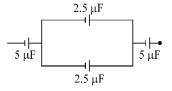
- ✓$\frac{5}{3} \mu F$
- B$\frac{3}{5} \mu F$
- C$15 \mu F$
- D$\frac{1}{15} \mu F$
Generate a complete, print-ready paper with questions like this in minutes — across 16+ boards, with answer keys.
A point object O is placed on the principal axis of a convex lens of focal length f = 20cm at a distance of 40cm to the left of it. The diameter of the lens is 10cm. An eye is placed 60cm to right of the lens and a distance h below the principal axis. The maximum value of h to see the image is:
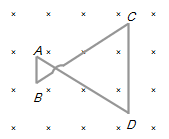
A conducting wire frame is placed in a magnetic field which is directed into the paper. The magnetic field is increasing at a constant rate. The directions of induced current in wires AB and CD are
|
(a) B to A and D to C |
(b) A to B and C to D |
|
(c) A to B and D to C |
(d) B to A and C to D |
In order to forward bias a PN junction, the negative terminal of battery is connected to
|
(a) P–side |
(b) Either P–side or N–side |
|
(c) N–side |
(d) None of these |
No bias is applied to a P-N junction, then the current
|
(a) Is zero because the number of charge carriers flowing on both sides is same |
|
(b) Is zero because the charge carriers do not move |
|
(c) Is non-zero |
|
(d) None of these |
A galvanometer, having a resistance of 50 W gives a full scale deflection for a current of 0.05 A. The length in meter of a resistance wire of area of cross-section 2.97 X 10⁻² cm2 that can be used to convert the galvanometer into an ammeter which can read a maximum of 5 A current is (Specific resistance of the wire = 5  Wm)
Wm)
|
(a) 9 |
(b) 6 |
(c) 3 |
(d) 1.5 |
To an observer on the earth the stars appear to twinkle. This can be ascribed to
|
(a) The fact that stars do not emit light continuously |
|
(b) Frequent absorption of star light by their own atmosphere |
|
(c) Frequent absorption of star light by the earth's atmosphere |
|
(d) The refractive index fluctuations in the earth's atmosphere |