Question
Establish a relation between electric current and drift velocity.
OR
Prove that the current density of a metallic conductor is directly proportional to the drift speed of electrons.
Answer

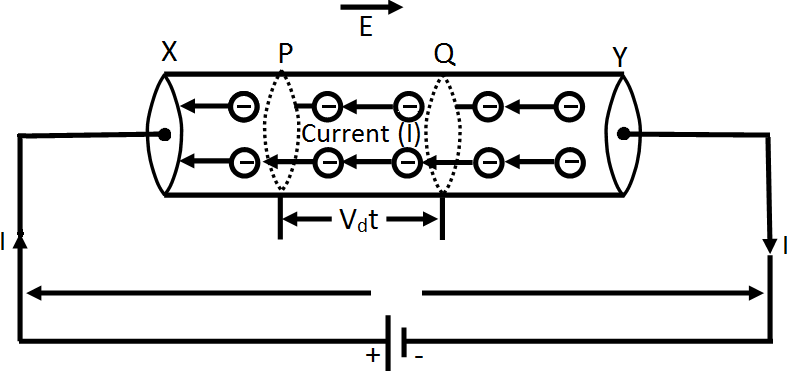
Relation between electric current and drift velocity: Consider a uniform metallic wire XY of length l and cross-sectional area A. A potential difference V is applied across the ends X and Y of the wire. This causes an electric field at each point of the wire of strength.

$\text{E}=\frac{\text{V}}{\text{l}}\dots\text{(i)}$ Due to this electric field, the electrons gain a drift velocity vd opposite to direction of electric field. If q be the charge passing through the cross-section of wire in t seconds, then $\text{Current in write I}=\frac{\text{q}}{\text{r}}\dots\text{(ii)}$ The distance traversed by each electron in time t = average velocity × time = vd t If we consider two planes P and Q at a distance vd t in a conductor, then the total charge flowing in time t will be equal to the total charge on the electrons present within the cylinder PQ. The volume of this cylinder = cross sectional area × height = A vd t If n is the number of free electrons in the wire per unit volume, then the number of free electrons in the cylinder = n(Avd t) If charge on each electron is $-e (e = 1.6 \times 10^{-19}C)$, then the total charge flowing through a cross-section of the wire $q = (nA_vd t) (-e) = –neA_vd t ...(iii)$ $\therefore$ Current flowing in the wire, $\text{I}=\frac{\text{q}}{\text{t}}=\frac{-\text{v}}{\text{t}}$ i.e., current I = -neAvd ...(iv) This is the relation between electric current and drift velocity. Negative sign shows that the direction of current is opposite to the drift velocity. Numerically I = -neAvd ...(v) $\therefore$ Current density, $\text{J}=\frac{\text{I}}{\text{A}}=\text{d}$ $\Rightarrow\text{J}\propto\text{vd.}$ That is, current density of a metallic conductor is directly proportional to the drift velocity.

Need a full question paper?

Generate a complete, print-ready paper with questions like this in minutes — across 16+ boards, with answer keys.

Start Generating Free

Similar questions

A source emitting sound at frequency 4000Hz, is moving along the Y-axis with a speed of 22m/s. A listener is situated on the ground at the position (660m, 0). Find the frequency of the sound received by the listener at the instant the source the origin. Speed of sound in air = 330m/s.
The $\text{K}_\beta$ X-rays from certain elements are given below. Draw a Moseley-type plot of $\sqrt{\text{v}}$ versus Z for $\text{K}_\beta$ radiation.
Element
Ne
P
Ca
Mn
Zn
Br
Energy (keV)
0.858
2.14
4.02
6.51
9.57
13.3
A simple pendulum of length I is suspended through the ceiling of an elevator. Find the time period of small oscillations if the elevator,
  1. Is going up with an acceleration $a_0$
  2. Is going down with an acceleration $a_0$.
  3. Is moving with a uniform velocity.
Calculate potential on the axis of a disc of radius R due to a charge Q uniformly distributed on its surface.
Suppose the block of the previous problem is pushed down the incline with a force of 4N. How far will the block move in the first two seconds after starting from rest? The mass of the block is 4kg.
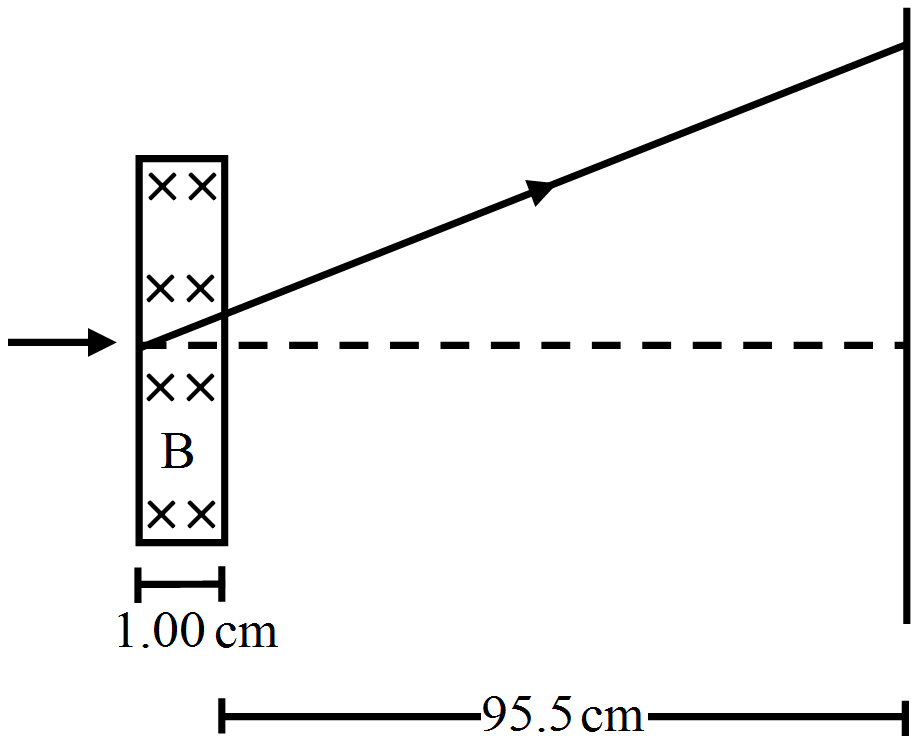
A narrow beam of singly charged potassium ions of kinetic energy 32keV is injected into a region of width 1.00cm with a magnetic field of strength 0.500T, as shown in the figure. The ions are collected at a screen 95.5cm away from the field region. If the beam contains isotopes of atomic weights 39 and 41, find the separation between the points where these isotopes strike the screen. Take the mass of a potassium ion $= A (1.6 \times 10^{-27})kg$, where A is the mass number.
  1. Draw a schematic sketch of a cyclotron. Explain clearly the role of crossed electric and magnetic field in accelerating the charge. Hence derive the expression for the kinetic energy acquired by the particles.
  2. An α–particle and a proton are released from the centre of the cyclotron and made to accelerate.
    1. Can both be accelerated at the same cyclotron frequency? Give reason to justify your answer.
    2. When they are accelerated in turn, which of the two will have higher velocity at the exit slit of the dees?
A room has AC run for 5 hours a day at a voltage of 220V. The wiring of the room consists of Cu of 1mm radius and a length of 10m. Power consumption per day is 10 commercial units. What fraction of it goes in the joule heating in wires? What would happen if the wiring is made of aluminium of the same dimensions?
$[\rho _{cu} = 1.7 \times 10^{-8}_{Ωm} , \rho _{Al} = 2.7 \times 10^{-8} Ωm]$
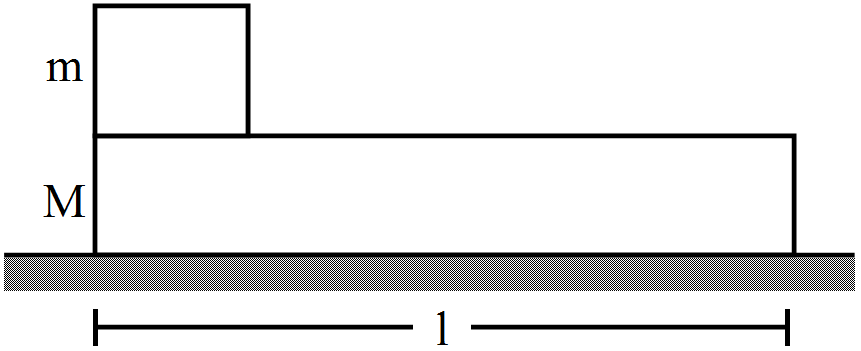
Figure shows a small block of mass m kept at the left end of a larger block of mass M and length l. The system can slide on a horizontal road. The system is started towards right with an initial velocity v. The friction coefficient between the road and the bigger block is g and that between the block is $\frac{\mu}{2}.$ Find the time elapsed before the smaller blocks separates from the bigger block.
Air is pumped into an automobile tyre's tube up to a pressure of 200kPa in the morning when the air temperature is 20°C. During the day the temperature rises to 40°C and the tube expands by 2%. Calculate the pressure of the air in the tube at this temperature.