Question
Establish the relation between electric field and potential gradient.

Answer

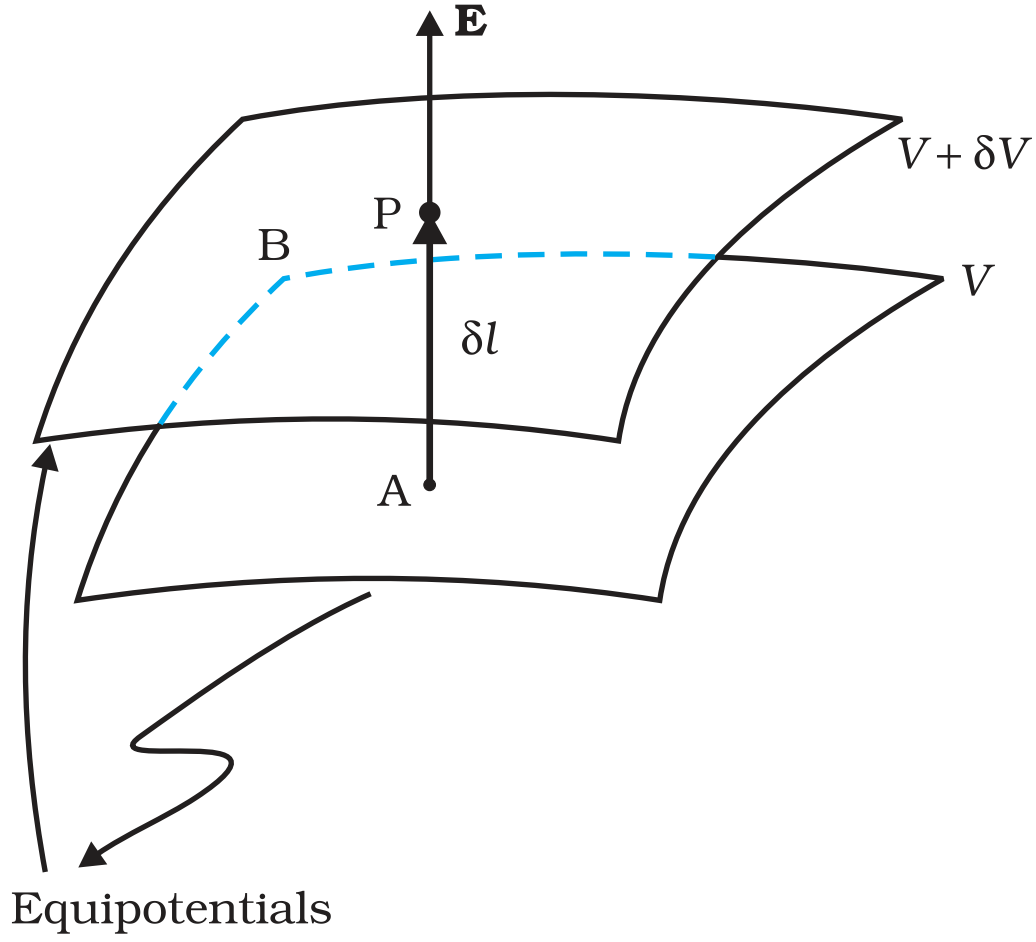
Let us consider two closely spaced equipotential surfaces A and B as shown in figure.

Let the potential of A be VA = V and potential of B be VB = V - dV where dV is decrease in potential in the direction of electric field $\vec{\text{E}}$ normal to A and B.

Let dr be the perpendicular distance between the two equipotential surfaces. When a unit positive charge is moved along this perpendicular from the surface B to surface A against the electric field, the work done in this process is:

$\text{W}_{\text{BA}}=-\vec{\text{E}}(\text{dr})$

This work done equals the potentail difference VA - VB,

$\therefore\text{W}_{\text{BA}}=\text{V}_{\text{A}}-\text{V}_{\text{B}}=\text{V}-(\text{V}-\text{dV})=\text{dV}$

$\therefore-\vec{\text{E}}=\text{dV}$

Or, $\vec{\text{E}}=-\frac{\text{dV}}{\text{dr}}$ = negative of potential gradlant.

Need a full question paper?

Generate a complete, print-ready paper with questions like this in minutes — across 16+ boards, with answer keys.
Start Generating Free

Similar questions

What is the speed of a photon with respect to another photon if:
  1. The two photons are going in the same direction and.
  2. They are going in opposite directions?
A block of mass M is kept on a rough horizontal surface. The coefficient of static friction between the block and the surface is $\mu.$ The block is to be pulled by applying a force to it. What minimum force is needed to slide the block? In which direction should this force act?
Find the current through the $10\Omega$ resistor shown in figure.

Explain the principle of superposition in terms of position vectors of charges.
Hari is a student of Class X in a school near his village. His uncle gifted him a bicycle with a dynamo fitted in it. He was thrilled to find that while cycling during night, he could light the bulb and see the objects on the road clearly. He, however, did not know how this device works. He asked this question to his teacher. The teacher considered it an opportunity and explained the working of a dynamo to the whole class.
Answer the following questions:
  1. State the principle and working of a dynamo.
  2. Write two values each displayed by Hari and his Science teacher.
Find the mass M of the hanging block in figure which will prevent the smaller block from slipping over the triangular block. All the surfaces are frictionless and the strings and the pulleys are light.

A thin prism of angle $6.0^\circ,\omega=0.07$ and $\mu_\text{y}=1.50$ is combined with another thin prism having $\omega=0.08$ and $\mu_\text{y}=1.60.$ The combination produces no deviation in the mean ray.
  1. Find the angle of the second prism.
  2. Find the net angular dispersion produced by the combination when a beam of white light passes through it.
  3. If the prisms are similarly directed, what will be the deviation in the mean ray
  4. Find the angular dispersion in the situation described in (c).
An ideal gas having density 1.7 × 10-3g-cm-3 at a pressure 1.5 × 105Pa is filled in a Kundt tube. When the gas is resonated at a frequency of 3.0KHz, nodes are formed at a separation of 6.0cm. Calculate the molar heat capacities CP and Cv of the gas.
Five long wires A, B, C, D and E, each carrying current I are arranged to form edges of a pentagonal prism as shown in Fig. Each carries current out of the plane of paper.

  1. What will be magnetic induction at a point on the axis O? Axis is at a distance R from each wire.
  2. What will be the field if current in one of the wires (say A) is switched off?
  3. What if current in one of the wire (say) A is reversed?
Consider N = n1n2 identical cells, each of emf $\in$ and internal resistance r. Suppose n1 cells are joined in series to form a line and n2 such lines are connected in parallel. The combination drives a current in an external resistance R. (a) Find the current in the external resistance. (b) Assuming that n1 and n2 can be continuously varied, find the relation between n1, n2, R and r for which the current in R is maximum.