MCQ
Ethanol is converted into ethyl chloride by reacting with
- A$C{l_2}$
- ✓$SOC{l_2}$
- C$HCl$
- D$NaCl$
Generate a complete, print-ready paper with questions like this in minutes — across 16+ boards, with answer keys.
$(I)$ $CH_3CH_2CH_2Cl$ $(II)$ $\begin{array}{*{20}{c}} {C{H_2} = CH\,CH\,C{H_3}} \\ {\,\,\,\,\,\,\,\,\,\,|} \\ {\,\,\,\,\,\,\,\,\,\,Cl} \end{array}$
$(III)$ $\begin{array}{*{20}{c}} {C{H_3}C{H_2}\,CH\,C{H_3}} \\ {\,\,\,|} \\ {\,\,\,\,Cl} \end{array}$
Statement $I$: Aniline reacts with con. $\mathrm{H}_2 \mathrm{SO}_4$ followed by heating at $453-473 \mathrm{~K}$ gives $\mathrm{p}$ aminobenzene sulphonic acid, which gives blood red colour in the 'Lassaigne's test'.
Statement $II$: In Friedel - Craft's alkylation and acylation reactions, aniline forms salt with the $\mathrm{AlCl}_3$ catalyst. Due to this, nitrogen of aniline aquires a positive charge and acts as deactivating group.
In the light of the above statements, choose the correct answer from the options given below :
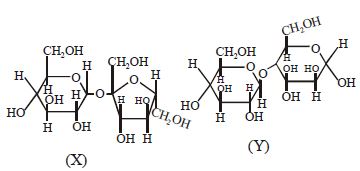
(At. mass of $Ag= 108\,u$)
$1\,L$ Solution $( X )+ AgNO _3$ solution (excess) $\rightarrow Y$
$1\,L$ Solution $( X )+ BaCl _2$ solution (excess) $\rightarrow Z$
The number of moles of $Y$ and $Z$ respectively are
(Nearest integer)
[Use : Molal Freezing point depression constant of water $\left.=1.86 \,\mathrm{~K} \,\mathrm{~kg} \,\mathrm{~mol}^{-1}\right]$
Freezing Point of water $=273\, \mathrm{~K}$
Atomic masses : $\mathrm{C}: 12.0\, \mathrm{u}, \mathrm{O}: 16.0\, \mathrm{u}, \mathrm{H}: 1.0\, \mathrm{u}]$