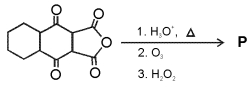
MCQ
Ethers show dipolar nature due to the presence of $........$
- ACentral $C$ atom
- ✓Central $O$ atom
- CCentral $N$ atom
- DNone of these
Generate a complete, print-ready paper with questions like this in minutes — across 16+ boards, with answer keys.
$\begin{matrix}
\begin{matrix}
\,\,\,\,\,C{{H}_{3}} \\
| \\
\end{matrix}\,\,\,\,\,\,\,\,\,\,\,\,\,\,\,\,\,\,\,\,\, \\
C{{H}_{3}}-C-C{{H}_{2}}C{{H}_{2}}OH \\
|\,\,\,\,\,\,\,\,\,\,\,\,\,\,\,\,\,\,\,\,\, \\
C{{H}_{3}}\,\,\,\,\,\,\,\,\,\,\,\,\,\,\, \\
\end{matrix}$ $\xrightarrow[{{H_2}O,heat}]{{{K_2}C{r_2}{O_7};{H_2}S{O_4}}}A$ $\xrightarrow{{SOC{l_2}}}B\xrightarrow[{(2{\kern 1pt} mole)}]{{{{(C{H_3})}_2}NH}}C$ $\xrightarrow[{2.{\kern 1pt} {H_2}O}]{{\begin{array}{*{20}{c}}
{1.{\kern 1pt} LiAl{H_4}} \\
{diethyl{\kern 1pt} {\kern 1pt} ether}
\end{array}}}D$
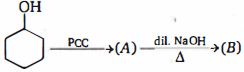
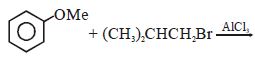
$(i)\,\,$on doubling the initial concentration of $A$ only, the rate of reaction is also doubled and
$(ii)$ on doubling the initial concentration of both $A$ and $B,$ there is a change by a factor of $8$ in the rate of the reaction.
The rate of this reaction is given by
Reason : It has a plane of symmetry.