MCQ
Ethyl benzoate reacts with $PC{l_5}$ to give
- A${C_2}{H_5}Cl + {C_6}{H_5}COCl + POC{l_3} + HCl$
- ✓${C_2}{H_5}Cl + {C_6}{H_5}COCl + POC{l_3}$
- C$C{H_3}COCl + {C_6}{H_5}COCl + POC{l_3}$
- D${C_2}{H_5}Cl + {C_6}{H_5}COOH + POC{l_3}$
$C _6 H _5 COOCH _2 CH _3+ PCl _5 \rightarrow \underset{\text { Ethyl chloride }}{ C _2 H _5 Cl }+\underset{\text { benzoyl chloride }}{ C _6 H _5 COCl }+\underset{\text { phosphorous oxy chloride }}{ POCl _3}$
Generate a complete, print-ready paper with questions like this in minutes — across 16+ boards, with answer keys.
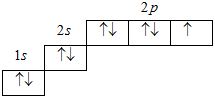
Product "$A$" is :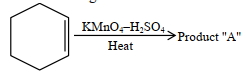
Which of the following cation does not respond to the above reaction ?
$C{H_3}COOH + PC{l_5} \to A\mathop {\xrightarrow{{{C_6}{H_6}}}}\limits_{anh.\,AlC{l_3}} $ $B\mathop {\xrightarrow{{{C_2}{H_5}MgBr}}}\limits_{ether} C$
$(i)$ Magnetic quantum no. $(m_l )$ gives information about the spatial orientation of orbitals with respect to standard set of co-ordinate axis.
$(ii)$ Electron spin quantum no. is represented by '$s$' and have value' $\frac{1}{2}$ '
$(iii)$ Principal quantum no. $(n)$ determine the size of the orbitals and also to a large extent of the energy of the orbitals.
$I$. $-I$ Effect of nitro group.
$II$. Greater resonance effect of $p-$ nitrophenoxy group
$III$. Steric effect of bulky nitro group