MCQ
Ethylene dichloride and ethylidine chloride are isomeric compounds. The false statement about these isomers is that they
  • A
    React with alcoholic potash and give the same product
  • B
    Are position isomers
  • C
    Contain the same percentage of chlorine
  • Are both hydrolysed to the same product
Answer

Correct option: D.
Are both hydrolysed to the same product
d
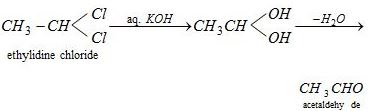
(d) On hydrolysis, ethylene dichloride gives ethylene glycol. While ethylidine chloride give acetaldehyde.

$\mathop {C{H_2}Cl.C{H_2}Cl}\limits_{{\text{ethylene dichloride}}} \xrightarrow{{{\text{aq}}{\text{. }}KOH}}\mathop {C{H_2}OH - C{H_2}OH}\limits_{{\text{glycol}}} $

Need a full question paper?

Generate a complete, print-ready paper with questions like this in minutes — across 16+ boards, with answer keys.

Start Generating Free

Similar questions

We have taken a saturated solution of $\mathrm{AgBr} . \mathrm{K}_{\text {sp }}$ of $\mathrm{AgBr}$ is $12 \times 10^{-14}$. If $10^{-7} \mathrm{~mole}$ of $\mathrm{AgNO}_3$ are added to $1$ litre of this solution find conductivity (specific conductance) of this solution in terms of $10^{-7} \mathrm{~S} \mathrm{~m}^{-1}$ units.

Given, $\lambda_{\left(\mathrm{Ag}^{+}\right)}^{\circ}=6 \times 10^{-3} \mathrm{Sm}^2 \mathrm{~mol}^{-1}, \lambda_{\left(\mathrm{Br}^{-}\right)}^{\circ}=8 \times 10^{-3} \mathrm{Sm}^2 \mathrm{~mol}^{-1}, \lambda_{\left(\mathrm{NO}_{\mathrm{j}}\right)}^{\circ}=7 \times 10^{-3} \mathrm{Sm}^2 \mathrm{~mol}^{-1}$.

$x,\, y$ and $z$ are respectively

$MnO_4^ - \, + \,x{e^ - }\,\xrightarrow[{(Alkaline\,\,medium)}]{}MnO_4^{2 - }$

$MnO_4^ - \, + \,y{e^ - }\,\xrightarrow{{(Acidic\,\,medium)}}M{n^{2 + }}$

$MnO_4^ - \, + \,z{e^ - }\,\xrightarrow{{(Neutral\,\,medium)}}Mn{O_2}$

In a chemical reaction $A$ is converted into $B$ . The rates of reaction, starting with initial concentrations of $A$ as $2 \times {10^{ - 3}}\,M$ and $1 \times {10^{ - 3}}\,M$ , are equal to $2.40 \times {10^{ - 4}}\,M{s^{ - 1}}$ and $0.60 \times {10^{ - 4}}\,M{s^{ - 1}}$ respectively. The order of reaction with respect to reactant $A$ will be
Consider the following redox reaction :

$\mathrm{MnO}_4^{-}+\mathrm{H}^{+}+\mathrm{H}_2 \mathrm{C}_2 \mathrm{O}_4 \rightleftharpoons \mathrm{Mn}^{2+}+\mathrm{H}_2 \mathrm{O}+\mathrm{CO}_2$

The standard reduction potentials are given as below $\left(\mathrm{E}_{\mathrm{red}}^{\circ}\right)$

$\mathrm{E}_{\mathrm{MmO}_4^{-} / \mathrm{Mm}^{2+}}^{\circ}=+1.51 \mathrm{~V}$

$\mathrm{E}_{\mathrm{CO}_2 / \mathrm{H}_2 \mathrm{C}_2 \mathrm{O}_4}^{\circ}=-0.49 \mathrm{~V}$

If the equilibrium constant of the above reaction is given as $K_{\text {eq }}=10^x$, then the value of $x=$____ (nearest integer)

If nearly ${10^5}$ coulomb liberate $1\, gm$ equivalent of aluminium, then the amount of aluminium (equivalent weight $9$) deposited through electrolysis in $20$ minutes by a current of $50\, amp$ will be .............. $\mathrm{gm}$
Treatment of propionaldehyde with dil. $NaOH$ gives
The major product of the following reactions is
Hydrolysis of $C{H_3}C{H_2}N{O_2}$ with $85\%$ ${H_2}S{O_4}$ gives
Which of the following complex compounds will exhibit highest paramagnetic behaviour ?

(At. No. $Ti = 22, Cr = 24, Co = 27, Zn = 30$)

If the concentration is expressed in moles per litre, the unit of the rate constant for a first order reaction is