Question
Evaluate: $(-12)^3 + 7^3 + 5^3$​​​​​​​

Answer

$(-12)^3 + 7^3 + 5^3$​​​​​​​
We know: $x^3 + y^3 + z^3 - 3xyz$
$= (x + y + z)(x^2 + y^2 + z^2 - xy - yz - zx) x^3 + y^3 + z^3$
$= (x + y + z)(x^2 + y^2 + z^2 - xy - yz - zx) + 3xyz$
Here,$ x = (-12), y = 7, z$
$= 5 (-12)^3 + 7^3 + 5^3$
$= (-12 + 7 + 5)[(-12)^2 + 7^2 + 5^2 - 7(-12) - 35 + 60] + 3(-12) \times 35$
$= 0 - 1260$
$​​​​​​​= -1260$

Need a full question paper?

Generate a complete, print-ready paper with questions like this in minutes — across 16+ boards, with answer keys.
Start Generating Free

Similar questions

The curved surface area of a cylinder is $1320\ cm^2$ and its base had diameter $21\ cm$. Find the height and volume of the cylinder.
 Hameed has built a cubical water tank with lid for his house, with each other edge $1.5\ m$ long. He gets the outer surface of the tank excluding the base, covered with square tiles of side $25\ cm$ . Find how much he would spend for the tiles if the cost of tiles is $₹ 360$ per dozen.
Circles are described on the sides of a triangle as diameters. Proved that the circle on any two sides intersect each other on the third side (or third side produced).
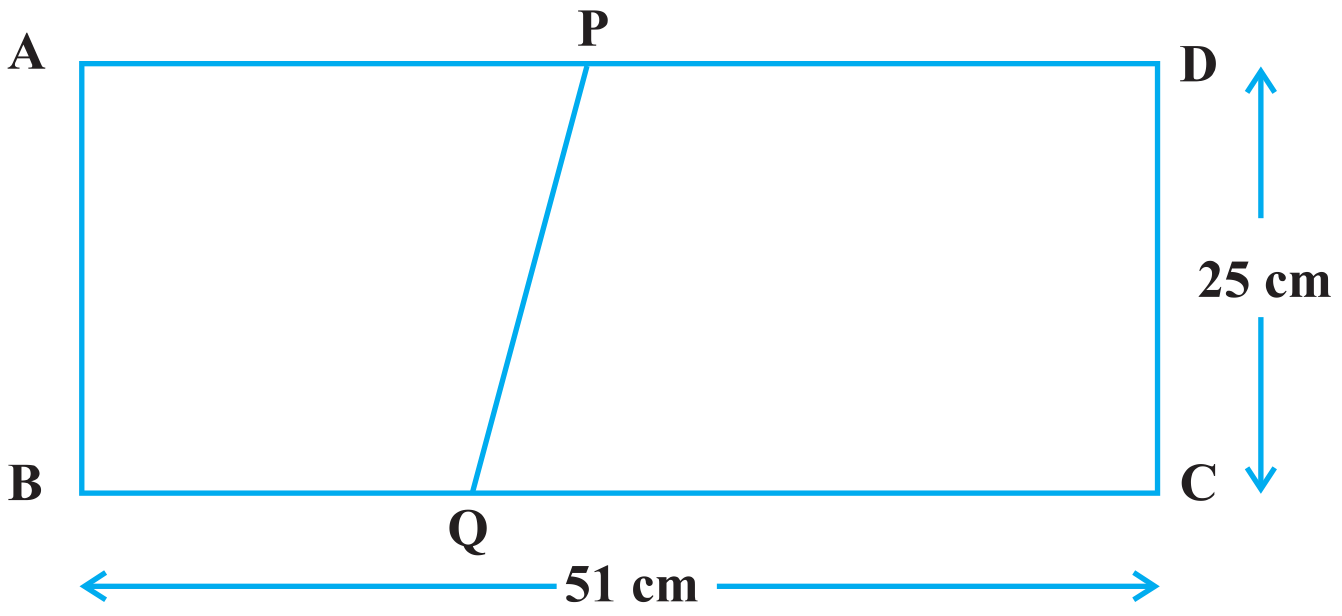
The dimensions of a rectangle $A B C D$ are $51 cm \times 25 cm$. A trapezium $PQCD$ with its parallel sides $QC$ and $PD$ in the ratio $9: 8$, is cut off from the rectangle as shown in the if the area of the trapezium $PQCD$ is $\frac{5}{6}$ th part of the area of the rectangle, find the lengths $QC$ and $PD.$​​​​​​​
A box made of sheet metal costs ₹ $6480$ at ₹ $120$ per square metre. If the box is $5m$ long and $3\ m$ wide, find its height.
The surface area of a sphere of radius $5\ cm$ is five times the area of the curved surface of a cone of radius $4\ cm$. Find the height of the cone.
Simplify by rationalising the denominator: $\frac{7\sqrt{3}-5\sqrt{2}}{\sqrt{48}+\sqrt{18}}$
Simplify: $(2x + p - c)^2 - (2x - p + c)^2$
Find rational numbers $a$ and $b$ such that: $\frac{5+2\sqrt{3}}{7+4\sqrt{3}}=\text{a}+\text{b}\sqrt{3}$
$ABC$ is a right triangle such that $AB = AC$ and bisector of angle $C$ intersects the side $AB$ at $D.$ Prove that $AC + AD = BC.$