Question
Evaluate: $\frac{7}{-27}+\frac{11}{18}$

Answer

$\frac{7}{-27}+\frac{11}{18}$
227,18
327,9
39,3
33,1
1,1

L.C.M. of 27 and $18=2 \times 3 \times 3 \times 3=54$
$ \begin{aligned} & \Rightarrow \frac{7 \times 2}{-27 \times 2}+\frac{11 \times 3}{18 \times 3} \\ & (\because \text { L.C.M. of }-27 \text { and } 18=54) \\ & \Rightarrow \frac{-14+33}{54}=\frac{19}{54} \mathrm{} \end{aligned} $

Need a full question paper?

Generate a complete, print-ready paper with questions like this in minutes — across 16+ boards, with answer keys.
Start Generating Free

Similar questions

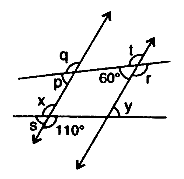
In the given figure, the directed lines are parallel to each other. Find the unknown angles.
What rational number should be subtracted from $\frac{5}{8}$ to get $\frac{8}{5}$.
Birju is a fruitseller. Today he bought pears to sell. He purchased them at the rate of 8 for ₹ 75 from the wholesale market.
Q.1. How many pears should he sell for 90 if he wishes to gain 20% ?
(a) 6 $\quad$$\quad$(b) 7$\quad$$\quad$ (c) 8$\quad$$\quad$ (d) 9
Q.2. He found that another fruitseller Ghanshyam was selling pears at 9 for₹90. Find the gain per cent of Ghanshyam. (Assume that the wholesale rate is the same for all fruitsellers.)
(a) $6 \frac{2}{3} \%$$\quad$$\quad$(b) $7 \frac{1}{2} \%$$\quad$$\quad$(c) $8 \frac{1}{3} \%$$\quad$$\quad$(d) $9 \frac{3}{3} \%$
Q.3. He decides to sell pears at the rate of 8 for₹90. Find his gain per cent :
(a) $15 \%$$\quad$$\quad$(b) $17 \frac{1}{2} \%$$\quad$$\quad$(c) $20 \%$$\quad$$\quad$(d) $22 \frac{1}{2} \%$
Q.4. In a box of 120 pears, he found that 24 were rotten and he had to throw them away. He sold the remaining pears at 8 for₹90. Find his gain or less per cent on this box :
(a) 2%, gain $\quad$$\quad$(b) 4%, loss $\quad$$\quad$$\quad$(c) 6%, gain$\quad$$\quad$ (d) 8%, loss
Evaluate: $\left(3 \frac{5}{12}+1 \frac{2}{3}\right) \div\left(3 \frac{5}{12}-1 \frac{2}{3}\right)$
Evaluate: $\frac{-5}{9}+\frac{-7}{12}+\frac{11}{18}$
Evaluate : $\frac{11}{15}-\frac{13}{20}$
Ram Nath sold one of his properties worth ₹ 38,00,000. He wished to divide this money between his two daughters Priya and Seema in the ratio $7: 12$. He sold another property for ₹ 60,00,000. He divided this money between Priya and Seema in the ratio  $\frac{1}{5}: \frac{1}{7}$.
Q.1. What amount did Priya receive from the sale of second property?
(a) ₹ 14,00,000 $\quad$$\quad$(b) ₹ 24,00,000$\quad$$\quad$ (c) ₹ 25,00,000 $\quad$$\quad$(d) ₹ 35,00,000
Q.2. What amount did Seema receive from the sale of first property?
(a) ₹ 14,00,000 $\quad$$\quad$(b) ₹ 24,00,000$\quad$$\quad$ (c) ₹ 25,00,000$\quad$$\quad$ (d) ₹ 49,00,000
Q.3. The difference between the total amounts received by Priya and Seema is:
(a) ₹ 0 $\quad$$\quad$(b) ₹ 1,00,000 $\quad$$\quad$(c) ₹ 2,00,000 $\quad$$\quad$(d) ₹ 5,00,000
Q.4. The ratio between the amounts received by Seema from the sale of the first and the second properties is :
(a) $1: 1$$\quad$$\quad$ (b) $12: 7$$\quad$$\quad$ (c) $24: 25$ $\quad$$\quad$(d) $14: 35$
Find the S.I. and amount on: 600 from July 12 to Dec. 5 at 10% p.a.
A man spends $\frac{2}{5}$ of his salary on food and $\frac{3}{10}$ of the remaining on house rent, electricity, etc. What fraction of his salary is still left with him?
Arrange the given rational numbers in descending order:
$\frac{5}{8}, \frac{13}{-16} \text { and } \frac{-7}{12}$