Question
Evaluate: $\frac{\cos 70^{\circ}}{\sin 20^{\circ}}+\frac{\cos 59^{\circ}}{\sin 31^{\circ}}-8 \sin ^2 30^{\circ}$
Answer

$\frac{\cos 70^{\circ}}{\sin 20^{\circ}}+\frac{\cos 59^{\circ}}{\sin 31^{\circ}}-8 \sin ^2 30^{\circ}$
$ =\frac{\cos \left(90^{\circ}-20^{\circ}\right)}{\sin 20^{\circ}}+\frac{\cos \left(90^{\circ}-31^{\circ}\right)}{\sin 31^{\circ}}-8\left(\frac{1}{2}\right)^2 $
$=\frac{\sin 20^{\circ}}{\sin 20^{\circ}}+\frac{\sin 31^{\circ}}{\sin 31^{\circ}}-2$
$= 1 + 1 - 2$
$= 0$

Need a full question paper?

Generate a complete, print-ready paper with questions like this in minutes — across 16+ boards, with answer keys.

Start Generating Free

Similar questions

The diagonal of a rectangular plot is $34 \ m$ and its perimeter is $92 \ m$. Find its area.
In right$-$angled triangle $A B C ; \angle B=90^{\circ}$. Find the magnitude of angle $A$, if:$a. A B$ is $\sqrt{3}$ times of $B C$.$B . B C$ is $\sqrt{3}$ times of $B C$.
The count of bacteria in a culture grows by 10% during first hour, decreases by 8% during second hour and again increases by 12% during third hour. If the count of bacteria in the sample is 13125000, what will be the count of bacteria after 3 hours?
A ladder 13 m long rests against a vertical wall. If the foot of the ladder is 5 m from the foot of the wall, find the distance of the other end of the ladder from the ground.
A footpath of uniform width runs all around the outside of a rectangular field $30 \ m$ long and $24 \ m$ wide. If the path occupies an area of $360 m^2$, find its width.
Image
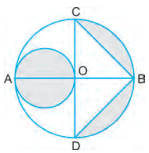
In the given figure, AB is the diameter of a circle with centre O and OA = 7 cm.
Find the area of the shaded region.
[Hint : OA = OB = OC = OD = 7 cm and $\angle B O C=90^{\circ}$
$\begin{array}{l}B C^2=O B^2+O C^2=(49+49)=98 \Rightarrow B C=\sqrt{98}=7 \sqrt{2} cm \\ \text { Area of } \triangle D B C=\frac{1}{2} \times B C \times B D=\left(\frac{1}{2} \times 7 \sqrt{2} \times 7 \sqrt{2}\right) cm ^2=49 cm^2\end{array}$
Required Area = (Area of smaller circle) + (Area of semi-circle CBD) - (Area of $\Delta$DBC)
$\left.=\left\{\left(\frac{22}{7} \times \frac{7}{2} \times \frac{7}{2}\right)+\left(\frac{1}{2} \times \frac{22}{7} \times 7 \times 7\right)-49\right\} cm ^2\right]$
Factorise : $6 x^2+11 x-10$
Calculate the amount and the compound interest on ₹ 15000 for 2 years compounded annually, the rates of interest for the successive years being 8% and 9% per annum respectively.
Draw the graph for the linear equation given below$:2y - 5 = 0$
In the figure, $AC = AE, AB = AD$ and $\angle BAD = \angle EAC.$ Prove that $BC = DE.$
Image ​​​​​​​