Question
Evaluate: $\int \sec ^2(7-4 x) d x$

Answer

(d) : Let $I=\int \sec ^2(7-4 x) d x$
Put $7-4 x=t \Rightarrow d x=\frac{-1}{4} d t$
$
\therefore \quad I=\int \frac{\sec ^2 t}{-4} d t \Rightarrow I=\frac{\tan t}{-4}+C=\frac{\tan (7-4 x)}{-4}+C
$

Need a full question paper?

Generate a complete, print-ready paper with questions like this in minutes — across 16+ boards, with answer keys.
Start Generating Free

Similar questions

Choose the correct answers from the given four options:
If $\text{y}=\log\Big(\frac{1-\text{x}^2}{1+\text{x}^2}\Big),$ then $\frac{\text{dy}}{\text{dx}}$ is equal to:
  1. $\frac{4\text{x}^3}{1-\text{x}^4}$
  2. $\frac{-4\text{x}}{1-\text{x}^4}$
  3. $\frac{1}{4-\text{x}^4}$
  4. $\frac{-4\text{x}^3}{1-\text{x}^4}$
(2, -3, -1) 2x - 3y + 6z + 7 = 0:
  1. 4
  2. 3
  3. 2
  4. $\frac{1}{5}$
If A and B are two events such that $\text{P(A)}=\frac{3}{8},\text{P(B)}=\frac{5}{4}.$ and $\text{P}(\text{A}|\text{B})\times\text{P}(\overline{\text{A}}\cap\text{B})$ is equals to.
If $A$ is an invertible matrix, then det $(A^{-1})$ is equal to:
Region represented by $\text{x}\geq0, \text{y}\geq0$ is:
  1. First quadrant
  2. Second quadrant
  3. Third quadrant
  4. Fourth quadrant
If $ \begin{vmatrix} 6\text{i} &\text{amp;} -3\text{i} &\text{amp;} 1\\ 4 &\text{amp; } 3\text{i} &\text{amp;} -1 \\ 20 &\text{amp; } 3 &\text{amp; i}\end{vmatrix}=\text{x}+\text{iy},$ then?
  1. x = 3, y = 1
  2. x = 1, y = 3
  3. x = 0, y = 3
  4. x = 0, y = 0
Consider the system of equations:
$a_1x + b_1y + c_1z = 0$
$a_2x + b_2y + c_2z = 0$
$a_3x + b_3y + c_3z = 0,$
if $\begin{vmatrix}\text{a}_1&\text{b}_1&\text{c}_1\\\text{a}_2&\text{b}_2&\text{c}_2\\\text{a}_3&\text{b}_3&\text{c}_3\end{vmatrix}=0$, then the system has
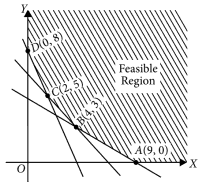
Feasible region for an L.P.P. is shown shaded in the following figure. Minimum of $Z=4 x+3 y$ occurs at the point
Image
The value of expression $\hat{i}, \hat{i}-\hat{j} \cdot \hat{j}+\hat{k} \cdot \hat{k}$ is-
The value of $\int\limits^\frac{\pi}{2}_{-\frac{\pi}{2}}\big(\text{x}^3+\text{x}\cos\text{x}+\tan^5\text{x}+1\big)\text{dx},$ is:
  1. 0
  2. 2
  3. $\pi$
  4. 1