Question
Evaluate : $\quad \int \frac{1}{3-10 x-25 x^2} \cdot d x$

Answer

$
\begin{aligned}
& I=\int \frac{1}{25\left(\frac{3}{25}-\frac{10}{25} x-x^2\right)} \cdot d x \\
& =\int \frac{1}{25\left[\frac{3}{25}-\left(x^2+\frac{2}{5} x\right)\right]} \cdot d x \\
& \because\left\{\left(\frac{1}{2} \text { coefficient of } x\right)^2\right. \\
& \left.=\left(\frac{1}{2}\left(\frac{2}{5}\right)\right)^2=\left(\frac{1}{5}\right)^2=\frac{1}{25}\right\} \\
& =\frac{1}{25} \cdot \int \frac{1}{\frac{3}{25}-\left(x^2-\frac{2}{5} x+\frac{1}{25}-\frac{1}{25}\right)} \cdot d x \\
& =\frac{1}{25} \cdot \int \frac{1}{\frac{3}{25}-\left(x^2-\frac{2}{5} x+\frac{1}{25}\right)+\frac{1}{25}} \cdot d x \\
& =\frac{1}{25} \cdot \int \frac{1}{\frac{4}{25}-\left(x^2-\frac{2}{5} x+\frac{1}{25}\right)} \cdot d x \\
& =\frac{1}{25} \cdot \int \frac{1}{\left(\frac{2}{5}\right)^2-\left(x-\frac{1}{5}\right)^2} \cdot d x \\
& \because \quad \int \frac{1}{a^2-x^2} \cdot d x=\frac{1}{2 a} \log \left(\frac{a+x}{a-x}\right)+c \\
& I=\frac{1}{25} \cdot \frac{1}{2\left(\frac{2}{5}\right)} \cdot \log \left(\frac{\frac{2}{5}+\left(x-\frac{1}{5}\right)}{\frac{2}{5}-\left(x-\frac{1}{5}\right)}\right)+c \\
& =\frac{1}{5} \cdot \log \left(\frac{1+5 x}{3-5 x}\right)+c \\
&
\end{aligned}
$

Need a full question paper?

Generate a complete, print-ready paper with questions like this in minutes — across 16+ boards, with answer keys.
Start Generating Free

Similar questions

Prove that the area common to tha two parabola $y = 2x^2 $and $y = x^2 + 4$ is $323$ sq. units.
Evaluate the following integrals as limit of sum:$\int\limits^{\frac{\pi}{2}}_{0}\sin\text{x dx}$
Without expanding, show that the values of the following determinant are zero:
$\begin{vmatrix}0&\text{x}&\text{y}\\-\text{x}&0&\text{z}\\-\text{y}&-\text{z}&0\end{vmatrix}$
Solve the following differential equation
$\frac{\text{dy}}{\text{dx}}-\text{x}\log\text{x}$
Using integration, find the area of the triangle $ABC$ coordinatrs of whise vertices $A(4, 1), B(6, 6)$ and $C(8, 4)$.

Image
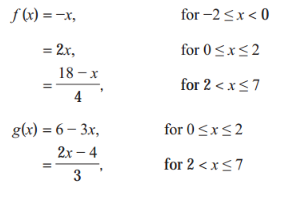
Let u(x) = f[g(x)], v(x) = g[f(x)] and w(x) = g[g(x)]. Find each derivative at x = 1, if it exists i.e. find u'(1), v'(1) and w'(1). if it doesn’t exist then explain why?
There are two types of fertilisers 'A' and 'B'. 'A' consists of 12% nitrogen and 5% phosphoric acid whereas 'B' consists of 4% nitrogen and 5% phosphoric acid. After testing the soil conditions, farmer finds that he needs at least 12kg of nitrogen and 12kg of phosphoric acid for his crops. If 'A' costs Rs. 10 per kg and 'B' cost Rs. 8 per kg, then graphically determine how much of each type of fertiliser should be used so that nutrient requiremnets are met at a minimum cost.
Using direction ratios show that the points A(2, 3, -4) B(1, - 2, 3) and C(3, 8, -11) are collinear.
If $x =a \sqrt{\sec \theta-\tan \theta}, y =a \sqrt{\sec \theta+\tan \theta}$, then show that $\frac{d y}{d x}=-\frac{y}{x}$
The position vectors of points A, B and C are $\lambda\hat{\text{i}}+3\hat{\text{j}},12\hat{\text{i}}+\mu\hat{\text{j}}\text{ and }11\hat{\text{i}}-3\hat{\text{j}}$ respectively. If C divides the line segment joining A and B in the ratio 3:1, find the value of $\lambda\text{ and }\mu$