Question
Evaluate the following definite integrals:
$\int_{1}^\limits{3}\frac{\log\text{x}}{(\text{x}+1)^2}\text{ dx}$

Answer

Let $\text{I}=\int_{1}^\limits{3}\frac{\log\text{x}}{(\text{x}+1)^2}\text{ dx}$ Then,
$\text{I}=\Big[\frac{-1}{1+\text{x}}\log\text{x}\Big]^3_1-\int_{1}^\limits{3}\Big(\frac{1}{\text{x}+1}\Big)\text{dx}$
$\Rightarrow\text{I}=\Big[\frac{-1}{1+\text{x}}\log\text{x}\Big]^3_1+\int_{1}^\limits{3}\frac{1}{\text{x}(\text{x}+1)}\text{ dx}$
$\Rightarrow\text{I}=\Big[\frac{-1}{1+\text{x}}\log\text{x}\Big]^3_1+\int_{1}^\limits{3}\Big(\frac{1}{\text{x}}-\frac{1}{\text{x}+1}\Big)\text{dx}$
$\Rightarrow\text{I}=\Big[\frac{-1}{1+\text{x}}\log\text{x}\Big]^3_1+\big[\log\text{x}-\log(\text{x}+1)\big]^3_1$
$\Rightarrow\text{I}=\frac{-1}{4}\log3+\log3-\log4+\log2$
$\Rightarrow\text{I}=\frac{3}{4}\log3-\log2$

Need a full question paper?

Generate a complete, print-ready paper with questions like this in minutes — across 16+ boards, with answer keys.
Start Generating Free

Similar questions

Let $f$ be a real function given by $\text{f(x)}=\sqrt{\text{x}-2}.$ Find the following: $fofof$ Also, show that $fof \neq f^2.$
If $A^{-1}=\left[\begin{array}{ccc}3 & -1 & 1 \\ -15 & 6 & -5 \\ 5 & -2 & 2\end{array}\right]$ and $B=\left[\begin{array}{ccc}1 & 2 & -2 \\ -1 & 3 & 0 \\ 0 & -2 & 1\end{array}\right]$ find $( A B)^{-1}$
Let $\text{A}=\begin{bmatrix}2&-3\\-7&5\end{bmatrix}$ and $\text{B}=\begin{bmatrix}1&0\\2&-4\end{bmatrix},$ verify that
$(\text{A}-\text{B})^\text{T}=\text{A}^\text{T}-\text{B}^\text{T}$
Evaluate: $\left|\begin{array}{ccc}\cos \alpha \cos \beta & \cos \alpha \sin \beta & -\sin \alpha \\ -\sin \beta & \cos \beta & 0 \\ \sin \alpha \cos \beta & \sin \alpha \sin \beta & \cos \alpha\end{array}\right|$
If $\begin{bmatrix}2&1&3\end{bmatrix}\begin{bmatrix}-1&0&-1\\-1&1&0\\0&1&1\end{bmatrix}\begin{bmatrix}1\\0\\-1\end{bmatrix}=\text{A},$ then find the value of A.
Given the relation R = {(1, 2), (2, 3)} on the set A = {1, 2, 3}, add a minimum number of ordered pairs so that the enlarged relation is symmeteric, transitive and reflexive.
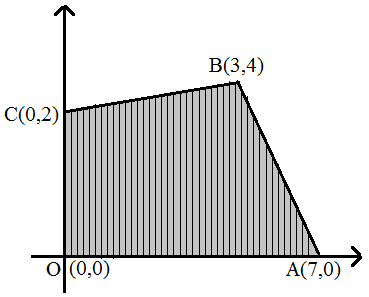
Feasible region (shaded) for a LPP is shown in Maximise Z = 5x + 7y.
Show that the tangents to the curve $y = 7x^3 + 11$ at the points $x = 2$ and $x = -2$ are parallel.
Evaluate the following integrals:
$\int\sin^4\text{x}\cos^3\text{x}\text{ dx}$
Find the mean and standard deviation of the following probability distributions$:$
$x_i$ $-3$ $-1$ $0$ $1$ $3$
$p_i$ $0.05$ $0.45$ $0.20$ $0.25$ $0.05$