Question
Evaluate the following integrals as limit of sum:
$\int\limits^2_{0}\big(\text{x}^2+1\big)\text{dx}$

Answer

$\int\limits^{\text{b}}_\text{a}\text{f(x)}\text{dx}=\lim\limits_{\text{h}\rightarrow0}\text{h}\Big[\text{f}(\text{a})+\text{f}(\text{a}+\text{h})+\text{f}(\text{a}+2\text{h})\ +\\ ....\ +\text{f}(\text{a}+(\text{n}-1)\text{h})\Big]$
Where, $\text{h}=\frac{\text{b}-\text{a}}{\text{n}}$
Here, $\text{a}=0,\text{ b}=2,\text{ f(x)}=\text{x}^2+1,\text{ h}=\frac{2-0}{\text{n}}=\frac{2}{\text{n}}$
Therefore, $\text{I}=\int\limits^2_{0}\big(\text{x}^2+1\big)\text{dx}$
$=\lim\limits_{\text{h}\rightarrow0}\text{h}\Big[\text{f}(0)+\text{f}(0+\text{h})+\ ....\ +\text{f}\big(0+(\text{n}-1)\text{h}\big)\Big]$
$=\lim\limits_{\text{h}\rightarrow0}\text{h}\Big[(0+1)+(\text{h}^2+1)+\ ....\ +\big\{(\text{n}-1)^2\text{h}^2+1\big\}\Big]$
$=\lim\limits_{\text{h}\rightarrow0}\text{h}\Big[\text{n}+\text{h}^2\big\{1^2+2^2+3^2+\ ....\ +(\text{n}-1)^2\big\}\Big]$
$=\lim\limits_{\text{h}\rightarrow0}\text{h}\Big[\text{n}+\text{h}^2\frac{\text{n}(\text{n}-1)(2\text{n}-1)}{6}\Big]$
$=\lim\limits_{\text{n}\rightarrow\infty}\frac{2}{\text{n}}\Big[\text{n}+\frac{2(\text{n}-1)(2\text{n}-1)}{3\text{n}}\Big]$
$=\lim\limits_{\text{n}\rightarrow\infty}2\bigg\{1+\frac{2}{3}\Big(1-\frac{1}{\text{n}}\Big)\Big(2-\frac{1}{\text{n}}\Big)\bigg\}$
$=2+\frac{8}{3}$
$=\frac{14}{3}$

Need a full question paper?

Generate a complete, print-ready paper with questions like this in minutes — across 16+ boards, with answer keys.

Start Generating Free

Similar questions

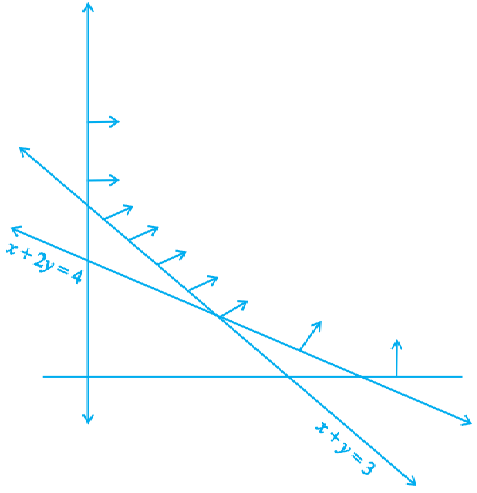
The feasible region for a LPP is shown in Evaluate Z = 4x + y at each of the corner points of this region. Find the minimum value of Z, if it exists.

Evaluate the following integrals:
$\int\text{e}^{2\text{x}}\cos(3\text{x}+4)\text{dx}$
A factory manufactures two types of screws A and B, each type requiring the use of two machines, an automatic and a hand-operated. It takes 4 minutes on the automatic and 6 minutes on the hand-operated machines to manufacture a packet of screws ‘A’ while it takes 6 minutes on the automatic and 3 minutes on the hand-operated machine to manufacture a packet of screws ‘B’. Each machine is available for at most 4 hours on any day. The manufacturer can sell a packet of screws ‘A’ at a profit of 70 paise and screws ‘B’ at a profit of Rs. 1. Assuming that he can sell all the screws he manufactures, how many packets of each type should the factory owner produce in a day in order to maximize his profit? Formulate the above LPP and solve it graphically and find the maximum profit.
Evaluate the following integrals:
$\int\text{x}\cos^3\text{x}^2\sin\text{x}^2\text{ dx}$
Evaluate the following integrals:
$\int\sqrt{1+\text{x}-2\text{x}^2}\text{dx}$
Find the area of the region bounded by the parabola y2 = 2x and the straight line x - y = 4
If $\vec{\text{a}}=\hat{\text{i}}+\hat{\text{j}}+2\hat{\text{k}}$ and $\vec{\text{b}}=2\hat{\text{i}}+\hat{\text{j}}-2\hat{\text{k}},$ find the unit vector in the direction of:
  1. $6\vec{\text{b}}$
  2. $2\vec{\text{a}}-\vec{\text{b}}$
Radium decomposes at a rate proportional to the quantity of radium present. It is found that in 25 years, approximately 1.1% of a certain quantity of radium has decomposed. Determine approximately how long it will take for one-half of the original amount of radium to decompose?
Find the particular solution of the differential equation $(\text{x}-\text{y})\frac{\text{dy}}{\text{dx}}=\text{x +2y},$ given that when x = 1, y = 0.
Solve the following differential equations:

$\frac{\text{dy}}{\text{dx}}=\frac{\text{e}^{\text{x}}(\sin^2\text{x}+\sin2\text{x})}{\text{y}(2\log\text{y}+1)}$