Question
Evaluate the following integrals as limit of sum:
$\int\limits^{3}_{1}\big(2\text{x}^2+5\text{x}\big)\text{dx}$

Answer

$\int\limits^{\text{b}}_\text{a}\text{f(x)}\text{dx}=\lim\limits_{\text{h}\rightarrow0}\text{h}\Big[\text{f}(\text{a})+\text{f}(\text{a}+\text{h})+\text{f}(\text{a}+2\text{h})\ +\\ ....\ +\text{f}(\text{a}+(\text{n}-1)\text{h})\Big]$
Where, $\text{h}=\frac{\text{b}-\text{a}}{\text{n}}$
Here, $\text{a}=1,\text{ b}=3,\text{ f(x)}=2\text{x}^2+5\text{x},\text{ h}=\frac{3-1}{\text{n}}=\frac{2}{\text{n}}$
Therefore, $\text{I}=\int\limits^{3}_{1}\big(2\text{x}^2+5\text{x}\big)\text{dx}$
$=\lim\limits_{\text{h}\rightarrow0}\text{h}\big[\text{f}(1)+\text{f}(1+\text{h})\ ....\ +\text{f}\big\{1+(\text{n}-1)\text{h}\big\}\big]$
$=\lim\limits_{\text{h}\rightarrow0}\text{h}=\lim\limits_{\text{h}\rightarrow0}\text{h}\Big[(2+5)+\big\{2(1+\text{h})^2+5(1+\text{h})\big\}+\ \\....+\ \big\{2(1+(\text{n}-1)\text{h}^2+5(1+(\text{n}-1)\text{h})\big\}\Big]$
$=\lim\limits_{\text{h}\rightarrow0}\text{h}\Big[2\Big\{1^2+(1+\text{h}^2)+\ ....+\ \big\{1+(\text{n}-1)\text{h}\big\}^2\Big\}+\\5\big\{1+(1+\text{h})+(1+2\text{h}+\ ....+\ (1+(\text{n}+1)\text{h}))\big\}\Big]$
$=\lim\limits_{\text{h}\rightarrow0}\text{h}\Big[2\text{n}+2\text{h}^2(1^2+2^2+3^2+\ ....\ +(\text{n}-1)^2+\\4\text{h}\big\{1+2+\ ....+ (\text{n}-1)\big\}+5\text{n}+5\text{h}\big\{1+2+\ ...+\ (\text{n}-1)\big\}\Big]$
$=\lim\limits_{\text{h}\rightarrow0}\text{h}\Big[7\text{n}+2\text{h}^2\frac{\text{n}(\text{n}-1)(2\text{n}-1)}{6}+9\text{h}\frac{\text{n}(\text{n}-1)}{2}\Big]$
$=\lim\limits_{\text{h}\rightarrow\infty}\frac{2}{\text{n}}\Big[7\text{n}+\frac{4(\text{n}-1)(2\text{n}-1)}{3\text{n}}+9\text{n}-9\Big]$
$=\lim\limits_{\text{h}\rightarrow\infty}2\Big[16+\frac{4}{3}\Big(1-\frac{1}{\text{n}}\Big)\Big(2-\frac{1}{\text{n}}\Big)-\frac{9}{\text{n}}\Big]$
$=32+\frac{16}{3}$
$=\frac{112}{3}$

Need a full question paper?

Generate a complete, print-ready paper with questions like this in minutes — across 16+ boards, with answer keys.
Start Generating Free

Similar questions

Divide 15 into two parts such that the square of one multiplied with the cube of the other is minimum.
Find one-parameter families of solution curves of the following differential equation: (or solve the following differential equation)$\frac{\text{dy}}{\text{dx}}+\text{y}\cos\text{x}=\text{e}^{\sin\text{x}}\cos\text{x}$
Solve the following differential equations:$(1+\text{y}^2)\tan^{-1}\text{xdx}+2\text{y}(1+\text{x}^2)\text{dy}=0$
A bag contains 20 tickets, numbered from 1 to 20. Two tickets are drawn without replacement. What is the probability that the first ticket has an even number and the second an odd number.
Solve the following initial value problems:
$\text{x}(\text{x}^2+3\text{y}^2)\text{dx}+\text{y}(\text{y}^2+3\text{x}^2)\text{dy}=0,\text{y}(1)=1$
Find the vector and cartesian equation of the line through the point (5, 2, -4) and which is parallel to the vector $3\hat{\text{i}}+2\hat{\text{j}}-8\hat{\text{k}}.$
$\text{If y} = \sqrt{\text{x + 1}} - \sqrt{\text{x - 1}}, \ \text{Prove that}\ (\text{x}^{2} - 1) \frac{\text{d}^{2}\text{y}}{\text{dx}^{2}} + \text{x} \frac{\text{dy}}{\text{dx}} - \frac{1}{4} \text{y}= 0.$
If $\begin{bmatrix}\text{x}&4&1\end{bmatrix}\begin{bmatrix}2&1&2\\1&0&2\\0&2&-4\end{bmatrix}\begin{bmatrix}\text{x}\\4\\-1\end{bmatrix}=0,$ find x.
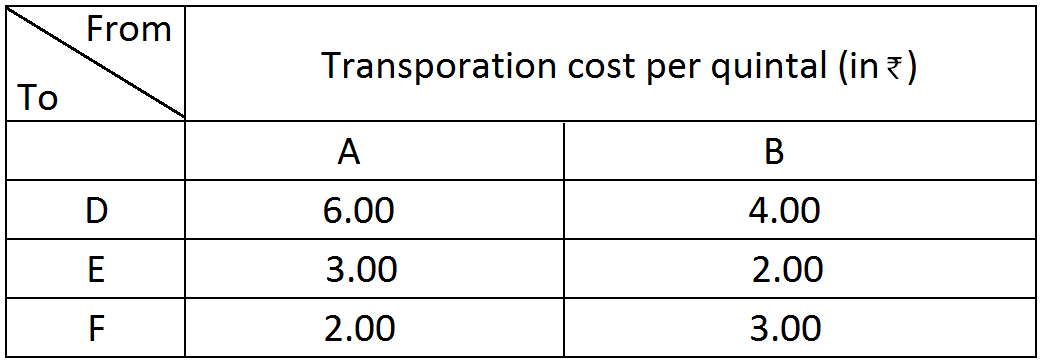
Tow godowns, A and B, have grain storage capacity of 100 quintals and 50 quintals respectively. They supply to 3 ration shops, D, E and F, whose requirements are 60, 50 and 40 quintals respectively. The cost of transportation per quintal from the godowns to the shops are given in the following table:

How should the supplies be transported in order that the transportation cost is minimum?
If $\text{A}=\begin{vmatrix}2&2&-4\\-4&2&-4\\2&-1 &5\end{vmatrix}\text{ and B}=\begin{vmatrix}1&-1&0\\2&3&4\\0&1&2\end{vmatrix},$ then find BA and use this to solve the system of equations y + 2z = 7, x - y = 3 and 2x + 3y + 4z = 17.