Question
Evaluate the following integrals:

$\int\frac{(\text{x}-1)^2}{\text{x}^2+2\text{x}+2}\text{ dx}$
Answer

Let $\int\frac{(\text{x}-1)^2}{\text{x}^2+2\text{x}+2}\text{ dx}$

$=\int\Big(\frac{\text{x}^2-2\text{x}+1}{\text{x}^2-2\text{x}+2}\Big)\text{dx}$

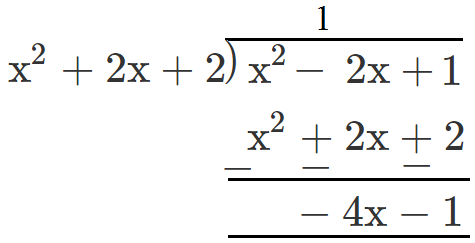
Here,

Therefore,

$\frac{\text{x}^2-2\text{x}+1}{\text{x}^2+2\text{x}+2}=1-\frac{(4\text{x}+1)}{\text{x}^2+2\text{x}+2}\ ....(1)$

Let $4\text{x}+1=\text{A}\frac{\text{d}}{\text{dx}}\big(\text{x}^2+2\text{x}+2\big)+\text{B}$

$4\text{x}+1=\text{A}(2\text{x}+2)+\text{B}$

$4\text{x}+1=(2\text{A})\text{x}+2\text{A}+\text{B}$

Equating Cofficients of like terms

$2\text{A}=4$

$\text{A}=2$

$2\text{A}+\text{B}=1$

$2\times2+\text{B}=1$

$\text{B}=-3$

$\int\Big(\frac{\text{x}^2-2\text{x}+1}{\text{x}^2-2\text{x}+2}\Big)\text{dx}$

$=\int\text{dx}-2\int\frac{(2\text{x}+2)}{\text{x}^2+2\text{x}+2}\text{ dx}+3\int\frac{\text{ dx}}{\text{x}^2+2\text{x}+2}$

$=\int\text{dx}-2\int\frac{(2\text{x}+2)}{\text{x}^2+2\text{x}+2}\text{ dx}+3\int\frac{\text{dx}}{(\text{x}+1)^2+1^2}$

$=\text{x}-2\log\big|\text{x}^2+2\text{x}+2\big|+\frac{3}{1}\tan^{-1}\Big(\frac{\text{x}+1}{1}\Big)+\text{C}$

$=\text{x}-2\log\big|\text{x}^2+2\text{x}+2\big|+3\tan^{-1}(\text{x}+1)+\text{C}$

Need a full question paper?

Generate a complete, print-ready paper with questions like this in minutes — across 16+ boards, with answer keys.

Start Generating Free

Similar questions

If $\text{y}=\tan^{-1}\Big(\frac{\sqrt{1+\text{x}}-\sqrt{1-\text{x}}}{\sqrt{1+\text{x}}+\sqrt{1+\text{x}}}\Big),$ find $\frac{\text{dy}}{\text{dx}}.$
A wholesale dealer deals in two kinds, A and B (say) of mixture of nuts. Each kg of mixture A contains 60 grams of almonds, 30 grams of cashew nuts and 30 grams of hazel nuts. Each kg of mixture B contains 30 grams of almonds, 60 grams of cashew nuts and 180 grams of hazel nuts. The remainder of both mixtures is per nuts. The dealer is contemplating to use mixtures A and B to make a bag which will contain at least 240 grams of almonds, 300 grams of cashew nuts and 540 grams of hazel nuts. Mixture A costs Rs. 8 per kg. and mixture B costs Rs. 12 per kg. Assuming that mixtures A and B are uniform, use graphical method to determine the number of kg. of each mixture which he should use to minimise the cost of the bag.
Verify Lagrange's mean value theorem for the following function on the indicated intervals. find a point 'c' in the indicated interval as stated by the Lagrange's mean value theorem.
f(x) = x- 5x2 - 3x on [1, 3]
Form the differential equation by eliminating A and B in Ax2 + By2 = 1.
If $\text{A}=\begin{bmatrix}3&-2\\4&-2\end{bmatrix}$ and $\text{I}=\begin{bmatrix}1&0\\0&1\end{bmatrix},$ then prove that A2 - A + 2I = O.
Find the particular solution of the differential equation satisfying the given conditions:
$\frac{\text{dy}}{\text{dx}}$= y tan x, given that y = 1 when x = 0.
Solve the following system of equations by matrix method:

$\frac{2}{\text{x}}-\frac{3}{\text{y}}+\frac{3}{\text{z}}=10$

$\frac{1}{\text{x}}+\frac{1}{\text{y}}+\frac{1}{\text{z}}=10$

$\frac{3}{\text{x}}-\frac{1}{\text{y}}+\frac{2}{\text{z}}=13$

If $\text{y}\log(1+\cos\text{x}),$ prove that $\frac{\text{d}^3\text{y}}{\text{dx}^3}+\frac{\text{d}^\text{y}}{\text{dx}^2}.\frac{\text{d}\text{y}}{\text{dx}}=0$
Find one-parameter families of solution curves of the following differential equation: (or solve the following differential equation)

$(\text{x}\log\text{x})\frac{\text{dy}}{\text{dx}}+\text{y}=\log\text{x}$

Solve the following differential equation:
$\text{x}\frac{\text{dy}}{\text{dx}}+\text{y}=\text{x}\log\text{x}$